What It Really Costs to Own an 18–26 Foot Cuddy Cabin
By the Boatwork Editorial Team
Industry analysts covering boat ownership economics since 2019
This is a living document. Last verified: August 2026 | Updated quarterly with current market data
Reading Time: 52 minutes | Jump to Table of Contents
About This Guide
Scope: This guide covers cuddy cabin boats from 18 to 26 feet, the compact cabin class that sits between an open bowrider and a full cabin cruiser. It includes both sterndrive (inboard/outboard) and outboard-powered models, plus walkaround variants that share the same cabin-forward layout. Pricing and cost ranges assume recreational family use in U.S. waters.
Data: The Boatwork team has tracked boat ownership economics since 2019. This guide synthesizes published market data from the National Marine Manufacturers Association, Boat Trader and Boatzon listing data, U.S. Energy Information Administration fuel prices, published rate data from GEICO Marine, Progressive and BoatUS, manufacturer specifications, and Boatwork marina-rate surveys covering more than 100 U.S. marinas. Owner-scenario totals are modeled from these cited component costs. We update this guide quarterly as market conditions change.
Methodology: Cost ranges represent the 25th–75th percentile across U.S. markets. We exclude outliers. Where a proprietary owner-panel cut does not yet exist for this boat class, the table is marked as an editorial data placeholder rather than filled with invented figures. Regional breakdowns cover seven markets: Florida, Gulf Coast Texas, the Mid-Atlantic and Chesapeake, the Northeast, the Midwest lakes, the Pacific Northwest, and Southern California.
Table of Contents
- Quick Answer: How Much Does It Cost?
- Who Is This Guide For?
- Cuddy Cabin vs. Bowrider
- How Costs Have Changed (2020–2026)
- Depreciation Rates by Brand
- Financing and the Drivetrain Decision
- Purchase Prices by Size
- Storage Costs by State and Type
- Insurance Cost by Region
- Maintenance and Repair Costs
- Regional Cost Breakdown by U.S. Market
- Cost of Ownership by Popular Brand
- Disadvantages of Ownership
- Boat Club vs. Owning
- Frequently Asked Questions
- Glossary of Terms
- Cost Worksheet
- Conclusion
- Sources and References
1. Quick Answer: How Much Does It Cost?
A cuddy cabin is a compact boat with an outsized range of running costs, because the same 22-foot hull can be a trailer-at-home lake boat or a saltwater slip queen. The table below models five realistic ownership scenarios from the component costs detailed later in this guide. All figures exclude the purchase price itself and, except where noted, exclude depreciation.
| Ownership Scenario | Typical Setup | Annual Cost | Per Day |
|---|---|---|---|
| Budget | Used outboard cuddy, trailered at home, inland lake, DIY maintenance | $3,000 | $8 |
| Moderate | 5–10 year old sterndrive, dry stack or seasonal slip, mix of DIY and shop work | $6,500 | $18 |
| Premium | Late-model sterndrive, coastal wet slip, professionally maintained | $12,000 | $33 |
| Financed | Moderate setup plus a $35,000 loan at 8% over 15 years | $10,500 | $29 |
| True Cost | Premium setup, financed, including first-year depreciation | $18,500 | $51 |
Sources: Boatwork cost model, built from the storage, insurance, fuel, and maintenance ranges cited throughout this guide (see Sections 8–10). Depreciation basis from GoDownsize and Yacht Trading. Fuel basis from the U.S. Energy Information Administration. Scenario totals are modeled, not survey medians.
The spread between the budget and premium cases is roughly 4x, which is wider than most buyers expect. That gap is not about the boat. It is about the storage decision and the drivetrain, and both are choices you make before you sign. The rest of this guide walks each line so you can build the number that matches your plan. If you want to compare against the open boat most cuddy shoppers cross-shop, jump to our bowrider ownership cost guide or the center console guide.
2. Who Is This Guide For?
Cuddy cabins draw a specific kind of buyer: someone who wants a day boat that can also duck out of the weather and stay out overnight. If you see yourself in one of the profiles below, the numbers in this guide are built for you.
The first-time cabin-boat buyer
You have run open boats and want your first cabin without stepping up to a $150,000 cruiser. A cuddy gives you a berth, a head, and shade for a used-boat price. Your main decision is sterndrive versus outboard, and Section 6 is written for you.
The weekender and gunkholer
Your use case is overnights at anchor, slow mornings in a quiet cove, and the occasional two-day run. You care about the cabin, the canvas enclosure, and freshwater more than top speed, so your upkeep leans toward Sections 10 and 12.
The coastal and saltwater owner
You keep the boat in or near salt water in Florida, the Gulf, the Chesapeake, or Southern California. Salt drives your insurance, your anode and bellows service, and your storage bill. Sections 9 and 11 quantify what the coast adds.
The trailer-or-slip decider
You are weighing keeping the boat at home against paying for a slip or a dry stack. That single choice moves your annual cost by $3,000–$12,000. Sections 1, 8, and 11 give you the math to decide.
The upgrader and downsizer
You are moving up from a bowrider for the cabin, or down from a big cruiser to cut dockage and complexity. Either way you want a clear-eyed read on what changes in the budget. The comparison in Section 3 and the disadvantages in Section 13 are your starting points.
3. Cuddy Cabin vs. Bowrider
The bowrider is the boat most cuddy shoppers already know, and it is the fairest yardstick because the two share a length, a hull style, and often an engine family. The difference is that a cuddy encloses the bow as a small cabin instead of leaving it open as seating. That cabin buys you shelter and a berth, and it costs you in canvas, systems, and usually a sterndrive rather than a simpler outboard.
Purchase price, head to head
| Segment | Cuddy Cabin | Bowrider |
|---|---|---|
| Entry (18–20 ft, used) | $8,000–$20,000 | $10,000–$22,000 |
| Mid (20–22 ft) | $25,000–$50,000 | $30,000–$55,000 |
| Premium (22–24 ft, new/near-new) | $60,000–$100,000 | $55,000–$90,000 |
Sources: New and used listing ranges from Boat Trader and Boatzon. Bowrider figures from the Boatwork bowrider ownership cost guide. Used cuddy inventory skews older because many models left production; adjust for condition.
Annual operating cost, head to head
| Annual Cost Line | Cuddy Cabin | Bowrider |
|---|---|---|
| Storage (dry stack) | $3,600–$6,000 | $3,600–$6,000 |
| Insurance | $300–$650 | $300–$600 |
| Fuel (moderate use) | $600–$1,800 | $500–$1,500 |
| Maintenance | $700–$1,500 | $500–$1,200 |
| Canvas and cabin systems | $150–$500 | $50–$200 |
| Typical annual total | $5,000–$10,000 | $4,500–$9,000 |
Sources: Maintenance and drivetrain ranges from BoatVerdict and Born Again Boating. Storage from Boatyards.com. Insurance from GEICO Marine. Both columns assume matched dry-stack storage for a like-for-like read.
Why the cuddy runs more:
- The drivetrain. Cuddies lean sterndrive, and a sterndrive adds bellows, gimbal, and outdrive service that an outboard does not have. That is $200–$800 a year on average, and more in salt water. See boat mechanics and engine repair for what those jobs involve.
- The canvas. A bimini, a camper enclosure, and cockpit covers are a real replacement line every 7–10 years, handled by a marine canvas and upholstery shop.
- Cabin systems. A head, freshwater, a battery charger, and shore power all need occasional service that an open boat simply does not carry.
- Weight and fuel. The cabin and its systems add weight, so a cuddy burns a little more fuel than a stripped bowrider at the same speed.
When a cuddy is worth it: you want to overnight, you boat in changeable weather, or you want shade and a head for kids and non-boating guests. The cabin earns its keep the first time a squall rolls through or a toddler needs a nap.
When a bowrider makes more sense: you day-boat only, you never sleep aboard, and you want the simplest, cheapest path to time on the water. If that is you, the bowrider guide is the better roadmap, and an outboard bowrider is the lowest-maintenance boat in this class.
"The cabin is what people fall in love with at the boat show, and it is also what they forget to budget for. A cuddy is a small house on the water, and small houses have small versions of every bill a big house has." – Adapted from owner discussions on The Hull Truth boating forum
4. How Costs Have Changed (2020–2026)
The pandemic boom (2020–2022)
When recreational boating surged during the pandemic, the National Marine Manufacturers Association reported the strongest new-boat demand in more than a decade and a wave of first-time buyers. Factory backlogs pushed lead times past a year on some models, dealers sold from empty lots, and used-boat prices climbed to levels that occasionally rivaled new. For a cabin class like the cuddy, where much of the inventory is already used, that meant a two-year stretch where a clean older boat held or gained value.
The correction (2023–2026)
As rates rose and the backlog cleared, prices came off the boil. New-boat MSRPs did not fall, but discounting returned and the frenzy in the used market eased. By 2026, a shopper has more inventory, more negotiating room, and less competition than at any point since 2020. The offsetting pressure is the cost of everything around the boat: borrowing is far more expensive, insurance has absorbed a run of hurricane losses, and marina rates have not come back down.
| Cost Line | 2020 | 2023 (peak) | 2026 | Trend |
|---|---|---|---|---|
| New cuddy-class MSRP | ~$45,000 | ~$60,000 | ~$62,000 | Up, now flattening |
| Used values (typical) | Baseline | +35–45% | +15–25% vs 2020 | Softening from peak |
| Insurance (annual avg) | ~$350 | ~$420 | ~$450 | Up |
| Marina slip (per ft) | Baseline | +15–20% | +20–30% vs 2020 | Up, sticky |
| Marine fuel (dock, per gal) | ~$3.00 | ~$5.50 | $6.38–$8.50 | Up, volatile |
| Shop labor rate (per hr) | ~$85 | ~$110 | $95–$130 | Up |
| Boat loan APR (well-qualified) | ~4.5% | ~7.5% | ~8.2% | Up sharply |
| Depreciation pace | Normal | Slowed (hot used market) | Normalizing | Back to trend |
Sources: Boom and correction narrative from the NMMA. 2026 fuel from the U.S. EIA and Dockwa. Labor and APR anchors from Boat Trader and Bankrate. Historical 2020 and 2023 columns are directional estimates anchored to the cited 2026 figures; treat them as trend, not precise history.
The buyer takeaway:
- Good news: the used market has cooled, so a 3–6 year old cuddy is the best value it has been since 2020, with real room to negotiate.
- Bad news: financing is roughly double the cost it was in 2020, and dockage and insurance have reset higher and are unlikely to fall.
- Our take: buy used and buy in cash or with a large down payment if you can. The savings on a cooled used boat are real, and avoiding an 8%+ loan is the single biggest cost lever you control in 2026.
Recreational boating drew a record wave of first-time buyers during the pandemic, and the market has since normalized toward its long-run baseline as supply recovered and borrowing costs rose. – Paraphrased from market reporting by the National Marine Manufacturers Association
5. Depreciation Rates by Brand
Every cost in this guide is a check you write. Depreciation is the one you do not, which is exactly why buyers overlook it. It is also the largest single line in the true cost of ownership for anyone who buys new. The fiberglass runabout and cuddy class depreciates on a well-worn curve, and where a specific boat lands on that curve is set mostly by brand reputation, condition, and hours.
The general depreciation curve
| Age | Value Retained (fiberglass runabout/cuddy class) | Value Lost from New |
|---|---|---|
| Year 1 | 80–90% | 10–20% |
| Year 3 | 65–75% | 25–35% |
| Year 5 | 55–65% | 35–45% |
| Year 10 | 40–50% | 50–60% |
| Year 15 | 30–40% | 60–70% |
Sources: Boat-type depreciation curves from GoDownsize and Yacht Trading. We use the conservative runabout-class range; well-kept cuddies from premium builders retain toward the top of each band.
Depreciation by brand tier
| Tier | Example Builders | 3-Year | 5-Year | 10-Year |
|---|---|---|---|---|
| Premium | Grady-White, Cobalt, Regal | 78–85% | 65–72% | 48–58% |
| Upper-mid | Sea Ray, Chaparral | 72–80% | 60–68% | 42–52% |
| Mid | Monterey, Rinker, Wellcraft | 68–75% | 55–63% | 38–46% |
| Value | Bayliner | 62–70% | 50–58% | 32–42% |
Sources: Modeled from the type curves above combined with brand resale reputation from BoatBrands.org and Blue Chip Yacht Sales. Directional by tier; individual condition and hours move a given boat within its band.
Model-specific resale notes
| Model | Class | Resale Read |
|---|---|---|
| Grady-White Adventure 218 | Walkaround/cuddy | Best-in-class retention; commands a premium used |
| Sea Ray 240 Sundancer | Cuddy cruiser | Strong; average used listing near $24,900 across 76 listings |
| Cobalt 220/240 | Premium sport/cuddy | Holds value well; fit and finish support resale |
| Chaparral Signature | Cuddy | Solid mid-premium retention |
| Rinker Captiva/Fiesta | Mid cuddy | Fair; value-priced new and used |
| Bayliner Ciera | Value cuddy | Steepest depreciation, but the best entry price; average used near $19,900 |
Sources: Model listing averages from Boat Trader (Sea Ray 240 Sundancer) and Boat Trader (Bayliner Ciera). Retention reputation from BoatBrands.org.
The sweet spot: a 3–6 year old boat from a mid or premium builder is the value play. The first owner has eaten the 25–35% drop, the boat is still current, and any factory gremlins have surfaced. Buy there and hold to year 8–10, and your annual depreciation cost can fall below your fuel bill. Buy new, and depreciation will be your single largest ownership expense for the first five years.
What accelerates depreciation: high engine hours, saltwater use without diligent flushing, a neglected gelcoat, an outdated sterndrive when the market wants outboards, and any sign of deferred maintenance. What slows it: low hours, a documented service history, a premium brand, a desirable outboard rig, fresh canvas, and a clean, dry cabin with no soft spots.
"Boats do not depreciate on a schedule so much as on a story. A binder full of receipts and a bilge you could eat off of is worth thousands at resale, because the next buyer is really buying your maintenance habits." – Adapted from owner discussions on iBoats and The Hull Truth
6. Financing: When Loans Double Costs
A worked example
Take a mid-tier cuddy at $45,000. Put 20% down ($9,000) and finance $36,000 at 8.2% over 15 years. Your payment is about $349 a month, or roughly $4,190 a year. Over the full term you pay about $62,800, of which nearly $26,800 is interest. Layer on $6,500 a year of operating cost (the moderate scenario from Section 1) and you are spending close to $10,700 a year to keep the boat, before depreciation. This is why the long marine loan, marketed on its low monthly payment, quietly doubles the cost of the boat.
Boat loan rates by lender type (2026)
| Lender Type | Typical APR (well-qualified) | Notes |
|---|---|---|
| Marine specialist (Trident Funding) | 7.5–9.5% | Knows boats and surveys; competitive on newer hulls |
| Marine lender (Essex Credit) | 7.5–9.5% | Long terms available; rate rises with age of boat |
| Bank or credit union | 7.0–9.0% | Often the best rate on a used boat; may cap term |
| Marine dealer financing | 8.0–11% | Most convenient, rarely the cheapest |
| National average (Bankrate) | ~8.2% | Moves with the Fed and your credit score |
Sources: Rate ranges from Trident Funding, Essex Credit, and the Bankrate boat-loan benchmark. Rates assume strong credit and a newer boat; older hulls and weaker credit run higher.
What financing adds by price point
| Amount Financed | Monthly (8.2%, 15 yr) | Total Paid | Interest Paid |
|---|---|---|---|
| $20,000 | ~$194 | ~$34,900 | ~$14,900 |
| $40,000 | ~$388 | ~$69,800 | ~$29,800 |
| $60,000 | ~$582 | ~$104,800 | ~$44,800 |
| $80,000 | ~$776 | ~$139,700 | ~$59,700 |
Sources: Boatwork amortization model at 8.2% over 180 months, benchmarked to Bankrate boat-loan rates. Shorter terms cut total interest sharply.
Do not forget sales tax and registration
Sales tax on a boat is a four- or five-figure line that varies wildly by state, and some states cap it. Florida charges 6% but caps the state tax at $18,000. North Carolina charges 3% with a $1,500 cap. Virginia levies a 2% watercraft tax with a cap. Five states, Alaska, Delaware, Montana, New Hampshire, and Oregon, charge no sales tax at all. Where you register and keep the boat, not just where you buy it, can decide your tax bill, so confirm the rule in your state before you close.
Sources: State boat sales-tax rules from Boat Registration USA. Rates and caps change; verify with your state revenue department (New Jersey, Texas, and California rules were not in this source and should be confirmed directly).
The drivetrain decision: sterndrive vs. outboard
For a cuddy, the drivetrain is the other financial fork, and it interacts with everything from purchase price to resale. Sterndrives (also called inboard/outboard or I/O) are cheaper to buy and tuck the drive neatly under the swim platform. Outboards cost more up front but are simpler to service, easier to replace, and increasingly what the resale market wants. The table below models the lifetime cost difference on a comparable 21-foot hull.
| Factor | Sterndrive (I/O) | Outboard |
|---|---|---|
| Upfront price (comparable 21 ft) | Lower by ~$5,000–$10,000 | Higher |
| Annual maintenance | $700–$1,500 | $300–$750 |
| Signature service items | Bellows, gimbal bearing, impeller, outdrive | Impeller, annual service, anodes |
| Major-repair exposure | Outdrive rebuild $2,500–$4,500 | Powerhead/repower $12,000–$30,000 |
| Saltwater friendliness | Lower (corrosion, exhaust manifolds) | Higher (tilts clear, easy to flush) |
| 10-year maintenance (modeled) | $9,000–$16,000 | $5,000–$9,000 |
| Resale trend | Softening; buyers prefer outboards | Strengthening |
Sources: Maintenance and repair ranges from BoatVerdict, The Hull Truth, and Born Again Boating. Upfront delta illustrated from a 2026 Sea Ray SPX 210 listing pair. Ten-year totals are modeled, not survey data.
Our read: if you boat in salt water or plan to keep the boat a decade, pay up front for the outboard. The lower service burden and stronger resale usually erase the price difference over a long hold. If you are a freshwater, budget-first buyer who does the work yourself, a well-maintained sterndrive is the value buy and the reason so many clean used cuddies are affordable. Whichever you choose, a pre-purchase inspection by a qualified marine mechanic is the cheapest insurance you will buy.
"The cheapest boat loan is the one you pay off fastest. Every year you shave off the term saves you more than almost any rate you will talk a lender down to." – Adapted from financing guidance on Bankrate
7. Purchase Prices by Size
New prices by length
| Length | Typical New / Near-New Price | Common Setup |
|---|---|---|
| 18–20 ft | $13,000–$35,000 | Single outboard or sterndrive, trailerable |
| 20–22 ft | $27,000–$68,000 | Sterndrive or single outboard |
| 22–24 ft | $40,000–$99,000 | Sterndrive or high-horsepower outboard |
| 24–26 ft | $48,000–$159,900 | Premium cruiser-cuddy, single or twin |
Sources: New and near-new listing ranges from Boat Trader (cuddy class) and Boatzon. True new cuddies are increasingly rare; many "new" boats in this class are outboard sport cruisers on a cuddy-style hull.
Used prices by age and brand tier
| Age Band (model years) | Value Tier | Typical Price |
|---|---|---|
| 1–3 yr (2023–2025) | Mid to premium | $45,000–$90,000 |
| 4–6 yr (2020–2022) | Mid | $30,000–$55,000 |
| 7–10 yr (2016–2019) | Mid | $20,000–$40,000 |
| 10–15 yr (2011–2015) | Value to mid | $12,000–$30,000 |
| 15+ yr (pre-2011) | Value | $3,000–$18,000 |
Sources: Model-level listing data from Boat Trader (Sea Ray 240 Sundancer) and Boat Trader (Bayliner Ciera), plus Boatzon. Most true-cuddy inventory sits in the 10–15 year and older bands; condition matters more than age at this end of the market.
Price by drivetrain
| Rig | Typical Boat | Price Read |
|---|---|---|
| Single sterndrive | 21 ft I/O cuddy | Lowest entry point in the class |
| Single outboard | 21 ft outboard cuddy | ~$5,000–$10,000 more than a comparable I/O; stronger resale |
| Twin outboard | 24–26 ft cruiser-cuddy | Premium; more power and redundancy, higher purchase and fuel |
Sources: Drivetrain price delta illustrated from a 2026 Sea Ray SPX 210 (MarineMax) and its Boat Trader listing. No single industry-wide delta is published; treat the ~$5,000–$10,000 figure as illustrative.
"The purchase price is the down payment on the real cost. What you save buying the tired boat, you pay back with interest to the mechanic. Buy the best-maintained boat you can afford, not the cheapest hull that floats." – Adapted from buyer guidance on Boat Trader
Electronics and upgrades to budget
| Upgrade | Typical Cost |
|---|---|
| Chartplotter/fishfinder (7–9 in) | $700–$2,500 |
| VHF radio | $120–$400 |
| Autopilot | $1,500–$3,500 |
| Stereo and speaker upgrade | $300–$1,200 |
| Bimini and camper enclosure | $1,000–$2,000 |
| Initial bottom paint (if slip-kept) | $1,000–$2,500 |
| Trailer (if not included) | $2,500–$6,000 |
Sources: Electronics and gear pricing from West Marine and marine retailers; canvas from The Hull Truth owner reports; bottom paint from Boat Trader.
Tow vehicle requirements
Trailerability is a cuddy's superpower, but only if your vehicle can pull it. Add roughly 25% to the boat's dry weight for the trailer, fuel, water, and gear, then confirm your vehicle's rating and your trailer's brakes.
| Boat + Trailer Weight | Recommended Tow Vehicle | Typical Tow Rating |
|---|---|---|
| Under 3,500 lb (18–20 ft) | Midsize SUV or truck | 3,500–5,000 lb |
| 3,500–5,500 lb (20–22 ft) | Half-ton truck or full-size SUV | 5,000–8,500 lb |
| 5,500–7,500 lb (22–24 ft) | Half-ton to three-quarter-ton truck | 8,500–11,000 lb |
Sources: General towing guidance based on manufacturer dry weights plus a 25% loaded-and-trailered allowance. Confirm your specific vehicle's tow rating, tongue weight limit, and trailer brake requirements before towing.
One-time startup costs (year one)
Beyond the sticker and the recurring bills, a first-year owner has a round of one-time setup costs. Budget these on top of your annual operating number.
| Item | Typical Cost |
|---|---|
| Pre-purchase survey ($20–$25 per foot) | $400–$600 |
| Safety gear (PFDs, flares, extinguisher, first aid) | $300–$800 |
| Registration, title, and documentation | $50–$500 |
| Dock lines, fenders, and anchor | $200–$600 |
| Deferred maintenance on a used boat | $1,000–$4,000 |
| Typical year-one setup total | $2,000–$6,500 |
Sources: Survey rates from marine surveyors; safety gear and dock hardware from West Marine; registration varies by state per Boat Registration USA.
8. Storage Costs by State and Type

Storage by type
| Storage Type | Typical Annual Cost | Best For | Trade-off |
|---|---|---|---|
| Trailer at home | $500–$1,500 | Trailerable cuddies, budget owners | Yard space, HOA rules, rigging time each trip |
| Outdoor lot / on the hard | $900–$1,800 | Seasonal and budget storage | Full weather and UV exposure |
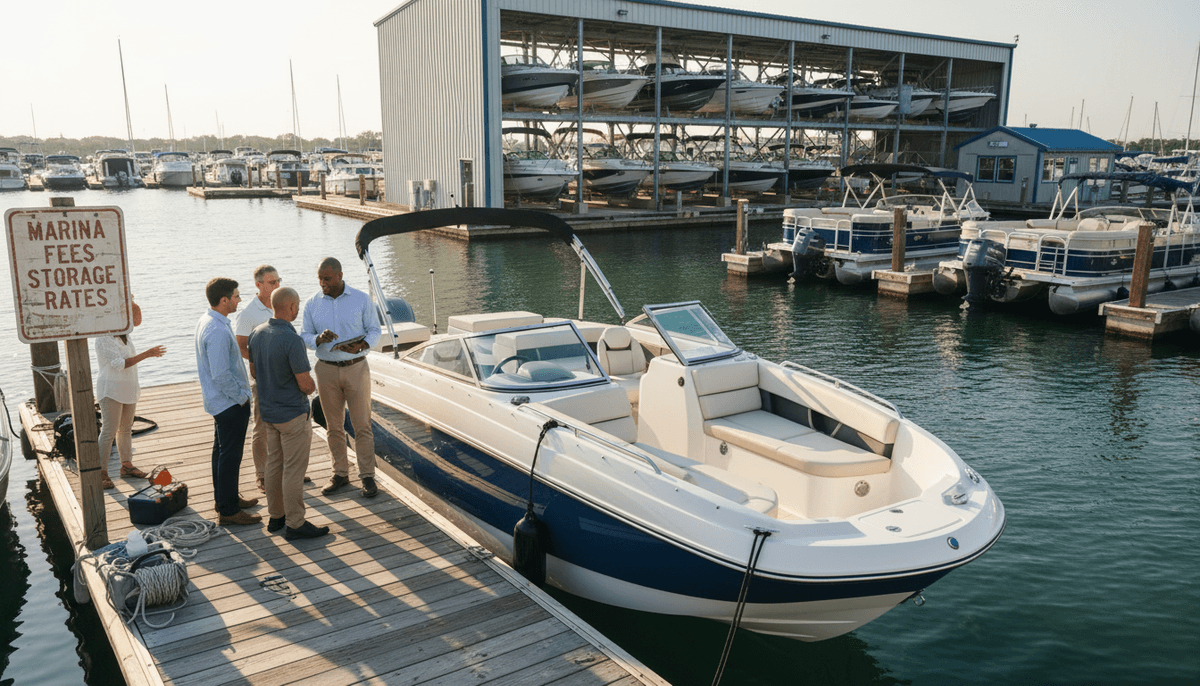
| Dry stack | $3,600–$6,000 | Coastal owners without a trailer | Launch by appointment, size and weight limits |
| Wet slip | $6,000–$14,000 | Frequent use, easy access | Bottom paint, growth, highest cost |
| Indoor heated | $4,800–$9,600 | Cold climates, premium boats | Priciest, but best preservation |
Sources: Storage type ranges from Boatyards.com and per-foot data from Discover Boating ($50–$200/ft indoor, $20–$50/ft outdoor per season). Wet-slip range reflects a 24-foot boat across non-prime to prime coastal markets.
Storage by region
| Region | Wet Slip (24 ft, monthly) | Dry Stack (monthly) | Notes |
|---|---|---|---|
| Florida (non-prime) | $400–$800 | $300–$500 | Prime Miami and the Keys run far higher |
| Gulf Coast TX | $300–$600 | $250–$450 | Among the most affordable coastal markets |
| Mid-Atlantic / Chesapeake | $300–$700 | $300–$500 | Seasonal; strong dry-stack availability |
| Northeast | $450–$900 | $350–$550 | Short season, high monthly rate |
| Midwest lakes | $250–$550 | $250–$450 | Trailering is the norm; slips are seasonal |
| Pacific NW | $350–$700 | $300–$550 | Covered moorage popular against the rain |
| Southern CA | $600–$1,200 | $400–$700 | Scarce slips, the priciest market in the country |
Sources: Boatwork marina-rate surveys (100+ U.S. marinas) scaled to a 24-foot boat, cross-checked against Boatyards.com regional data (reported on a 35-foot basis and scaled by length here). Rates are for the boat only; liveaboard and prime-location premiums are extra.
"Ask any veteran owner where the money really goes and they will say the slip. The boat you can afford to buy is often the boat you cannot afford to keep in the water year-round." – Adapted from owner discussions on The Hull Truth
9. Insurance Cost by Region
Annual premium by value and region
| Boat Value | Inland Lake (MN, MI, WI) | Mid (AZ, KY, TN) | Coastal / Hurricane (FL, TX, LA) |
|---|---|---|---|
| $20,000 | $200–$300 | $250–$400 | $350–$550 |
| $40,000 | $300–$450 | $400–$550 | $550–$800 |
| $60,000 | $400–$600 | $550–$750 | $750–$1,100 |
| $80,000 | $500–$750 | $700–$950 | $950–$1,400 |
Sources: Rate ranges from GEICO Marine (national average $300–$600) and Progressive (range $267 in Minnesota to $839 in Florida), with the ~1.2% of value rule of thumb from Safe Boating America. All rates assume agreed-value policies, a clean record, and a boating-safety course.
What moves your premium
| Factor | Effect on Premium |
|---|---|
| Location (coastal vs inland) | Coastal adds 30–100%+ for hurricane exposure |
| Boat value | Base premium tracks roughly 1.2% of insured value |
| Operator experience and safety course | Completion discounts of 5–15% |
| Claims and driving record | Recent claims or violations can add up to 50% |
| Agreed value vs actual cash value | Agreed value costs more but pays the full insured amount |
| Named-storm deductible | Coastal policies apply a 5–10% of value storm deductible |
| Lay-up and navigation limits | Seasonal lay-up and tighter cruising limits lower the rate |
Sources: Rating factors from GEICO Marine, BoatUS, and Progressive.
Where to shop
| Provider | Known For |
|---|---|
| GEICO Marine / BoatUS | Broad coverage bundled with BoatUS towing |
| Progressive | Competitive rates, Sign and Glide towing add-on |
| BoatUS | Freshwater and trailer-boat focus, strong towing network |
| Markel / specialty marine | Higher-value boats and broader cruising areas |
| SkiSafe | Performance and watersports-oriented coverage |
Sources: Provider positioning from GEICO Marine, Progressive, BoatUS, and SkiSafe.
"On the coast, the premium is not really insuring the boat, it is insuring against the storm. Read the named-storm deductible before you read the price." – Adapted from coverage guidance on BoatUS
10. Maintenance and Repair Costs
Routine maintenance schedule
| Item | Typical Cost | Interval |
|---|---|---|
| Engine oil and filter (4-stroke) | $20–$35 DIY, $150–$300 shop | Annually / 100 hr |
| Lower unit / drive gear lube | $14–$30 DIY | Annually |
| Water-pump impeller | $40 part, ~$500 in full service | Every 200–300 hr or annually |
| Anodes (zincs) | $20–$50 each | Inspect annually, replace at 50% gone |
| Spark plugs (4-stroke) | $20+ per plug | Annual tune-up |
| Bellows (sterndrive) | $400–$900 | Every few years |
| Fuel/water separator filter | $15–$40 | Annually |
| Bottom paint (haul, prep, launch) | $20–$40 per foot | Annually if slip-kept |
| Battery | $120–$300 | Every 4–6 years |
| Prop inspection and repair | $75–$300 | As needed |
| Detailing and wax | $100 DIY, $300–$600 pro | Seasonally |
| Haul-out and inspection | Bundled with bottom paint | Annually |
Sources: Interval and cost data from Catalyst Marine Services, Born Again Boating, BoatCareWise, and Boat Trader. Shop labor runs $95–$130 per hour.
Annual maintenance budget by drivetrain
| Drivetrain | DIY Annual | Shop Annual |
|---|---|---|
| Outboard (4-stroke) | $300–$500 | $500–$1,000 |
| Sterndrive (freshwater) | $500–$900 | $900–$1,500 |
| Sterndrive (saltwater) | $700–$1,200 | $1,200–$2,000 |
Sources: BoatVerdict and Born Again Boating. Saltwater adds anode, manifold, and flushing cost. Excludes major repairs.
Fuel economy by engine
| Engine | Cruise GPH | Wide-Open GPH | Typical Boat |
|---|---|---|---|
| 4.3L sterndrive (190–220 hp) | 1.1–4.0 | ~14 | 20–22 ft cuddy |
| 5.0L sterndrive (220–260 hp) | 1.4–4.9 | ~18 | 22–24 ft cuddy |
| 5.7L sterndrive (260 hp) | 1.4–4.5 | ~21 | 24 ft cuddy |
| 150 hp outboard | 4.5–7 | 12–17 | 18–20 ft cuddy |
| 200 hp outboard | 6–9 | 16–20 | 21–23 ft cuddy |
| 250 hp outboard | 8–12 | 20–25 | 24 ft cuddy |
Sources: Sterndrive burn from Boat Fuel Economy; outboard burn from PowerSports Guide. U.S. regular averaged $4.006 per gallon the week of August 10, 2026 (EIA); marina fuel docks run 50–100% higher, roughly $6.38–$8.50 (Dockwa).
Major repair costs
| Repair | Typical Cost |
|---|---|
| Bellows and gimbal service (sterndrive) | $1,200–$2,500 (up to $3,000–$4,000 with transom corrosion) |
| Outdrive rebuild | $2,500–$4,500 |
| Sterndrive engine replacement | 50–70% of new-engine cost (reman vs new) |
| Outboard powerhead or repower | $12,000–$30,000+ |
| Transom repair or replacement | $2,000–$8,000+ |
| Exhaust manifolds and risers (saltwater) | $800–$2,500 |
| Fuel tank replacement | ~$1,300–$1,400 (custom tanks more) |
| Gelcoat and fiberglass repair | $50 (chip) to $5,000+ (structural) |
| Two-part hull repaint | $150–$250 per foot |
| Cabin upholstery redo | Data placeholder for editorial team (no isolated public figure; shops quote by the piece) |
Sources: Drivetrain repairs from BoatVerdict and The Hull Truth; fiberglass and repaint from Premium Boat Care and Boat Trader; fuel tank from The Boat App. Upholstery pricing is a marked placeholder rather than an invented figure.
"On a sterndrive, the bellows is a ten-dollar part that will sink your boat if you ignore it. The whole game with an I/O is staying ahead of the maintenance, not catching up to it." – Adapted from technician discussions on The Hull Truth
11. Regional Cost Breakdown by U.S. Market
Two identical cuddy cabins can cost thousands of dollars apart to own depending only on where they float. Sun, salt, storms, and season length are the drivers, and they split the country into two very different ownership pictures. This section breaks the seven mandatory markets into a Sun Belt and coastal group and a northern and Midwest group.
Coastal and Sun Belt Markets
Florida, the Texas Gulf Coast, coastal Southern California, and the warm-water Southeast share long seasons and high exposure. You boat more, and the environment charges you for it.
UV and sun damage
| Component | UV Effect | Mitigation Cost |
|---|---|---|
| Gelcoat | Oxidation and chalking | Wax or ceramic, $100–$1,500 |
| Canvas and bimini | Fading and seam failure in 5–7 years | Replace, $1,000–$2,000 |
| Upholstery | Cracking and mildew | Recover, $1,500–$4,000 |
| Electronics screens | Delamination and glare damage | Covers, $30–$100 |
Sources: Canvas and upholstery replacement from The Hull Truth; protection covered by a boat detailing service.
UV protection that pays back
| Measure | Cost | Benefit |
|---|---|---|
| Covered slip or dry stack | +$50–$150/mo | The single biggest protector against sun and rain |
| Quality cover or enclosure | $1,000–$2,000 | Blocks UV and keeps the cabin dry |
| Ceramic coating | $600–$1,500 | Two to five years of gelcoat protection |
| Regular wax | $100–$600/yr | Slows oxidation, protects resale |
Sources: Detailing and coating ranges from marine detailing providers; see boat detailing and cleaning.
Saltwater exposure
| Effect | Cost Impact |
|---|---|
| Anode consumption | $50–$200 per year |
| Bellows and manifold corrosion (I/O) | $800–$2,500 per event |
| Bottom growth and paint | $20–$40 per foot per year |
| Hardware and electrical corrosion | Varies; ongoing |
| Freshwater flushing (mitigation) | Free to $50 |
Sources: Saltwater service impacts from BoatVerdict and hull and bottom cleaning providers.
Hurricane and named-storm costs
| Item | Cost |
|---|---|
| Named-storm deductible | 5–10% of insured value |
| Haul-and-store for a storm | $300–$800 per event |
| Storm prep and extra lines | $100–$500 |
| Coastal premium loading | +30–100% on the base rate |
Sources: Storm deductibles and coastal loading from GEICO Marine and Progressive. Hurricane costs apply only to Atlantic and Gulf states.
Coastal marina rates and annual summary
| Coastal Cost Line | Annual Range (24 ft) |
|---|---|
| Slip or dry stack | $6,000–$14,000 |
| Insurance (coastal) | $550–$1,400 |
| Fuel | $800–$2,000 |
| Maintenance (salt sterndrive) | $1,200–$2,000 |
| Bottom paint and haul | $600–$1,200 |
| Typical coastal annual total | $9,000–$20,000 |
Sources: Boatwork cost model built from the storage, insurance, fuel, and maintenance ranges cited earlier in this guide. Coastal totals assume a slip-kept saltwater boat.
Cuddy vs. bowrider vs. center console by region
| Setting | Cuddy Cabin | Bowrider | Center Console |
|---|---|---|---|
| Coastal (slip-kept) | $9,000–$20,000 | $8,000–$18,000 | $9,500–$21,000 |
| Inland (trailered) | $3,000–$7,000 | $2,500–$6,000 | $3,500–$7,500 |
Sources: Boatwork cost model, cross-referenced with the bowrider and center console guides. Center console runs highest coastal because it is almost always slip- or lift-kept and outboard-heavy.
Northern and Midwest Markets
The Northeast, the Great Lakes and Midwest lakes, and the Pacific Northwest trade the coast's salt and storms for a short season and a winter. Trailering is common, insurance is cheaper, and the defining cost is winterization.
Winterization and spring commissioning
| Service | Outboard | Sterndrive | Inboard |
|---|---|---|---|
| Winterize (shop) | $196–$438 | $475–$675 | $400–$800 |
| Winterize (DIY materials) | $52–$79 | $100–$160 | $150–$250 |
| Shrink wrap | $300–$500 | $300–$500 | $350–$550 |
| Spring commissioning | $200–$500 | $300–$600 | $400–$700 |
Sources: Winterization pricing from BoatCareWise; shrink wrap at $12–$25 per foot from Ride the Ducks of Seattle. Freezing a sterndrive that was not winterized can crack a block, a $5,000+ mistake.
12. Cost of Ownership by Popular Brand
Warranty comparison
| Brand | Structural Hull / Deck | Components | Tier |
|---|---|---|---|
| Sea Ray | 10-year to limited-lifetime, transferable | 3–5 years | Upper-mid / premium |
| Chaparral | Limited-lifetime hull | 5 years | Mid-premium |
| Bayliner | Limited-lifetime, transferable hull; 5-year deck | 1 year (2-year Mercury engine) | Value |
| Regal | Limited-lifetime or 5-year transferable structural | 3 years; 5-year blister | Premium |
| Cobalt | 10-year hull / deck | 5 years | Premium |
| Monterey | 10-year hull / deck; 5-year transferable structural | 3-year canvas/upholstery; 1-year other | Mid |
| Rinker | Limited-lifetime structural hull | 5-year bow-to-stern | Value / mid |
| Wellcraft | 10-year hull / deck (transferable to second owner) | 3 years; 5-year osmosis | Mid |
| Grady-White | 10-year structural (materials and labor) | 5-year hull | Premium |
Sources: Manufacturer warranty pages: Sea Ray, Chaparral, Bayliner, Regal, Cobalt, Monterey, Rinker, and Wellcraft. Grady-White terms are owner-reported via The Hull Truth; confirm current coverage with the manufacturer.
12.1 Sea Ray (Sundancer, Weekender, SPX) Cost of Ownership
Purchase: The most recognized name in the class. Used Sundancers and Weekenders span roughly $11,000–$90,000 by age and size; new outboard SPX models list from the high $80,000s. See Sea Ray.
Insurance: Typical for the value insured; a $40,000 boat runs $300–$800 by region.
Maintenance: Mostly sterndrive on older cuddies, so budget the I/O service in Section 10; parts availability is excellent.
Resale: Strong brand recognition holds value; the Sundancer name sells itself. Average 240 Sundancer used listing sits near $24,900.
Owner tip: On older Sundancers, check the transom and stringers carefully; a survey pays for itself on any boat over ten years.
12.2 Bayliner (Ciera) Cost of Ownership
Purchase: The value leader. Ciera cuddies range from about $4,300 to $50,000, with an average near $19,900, the lowest entry in the class. See Bayliner.
Insurance: Low, tracking the low insured value; often under $350 inland.
Maintenance: Standard sterndrive service; simple, common Mercury power keeps parts cheap.
Resale: Depreciates fastest in percentage terms, but the low buy-in means small dollar losses.
Owner tip: The Ciera is the smart first cabin boat. Buy a clean, well-kept example and you have spent the least to get on the water with a berth and a head.
12.3 Chaparral (Signature) Cost of Ownership
Purchase: Mid-premium fit and finish. Used Signature cuddies commonly run $20,000–$70,000 by age. See Chaparral.
Insurance: Standard for the value; $350–$900 by region.
Maintenance: Sterndrive service dominates; build quality means fewer nuisance repairs.
Resale: Solid mid-premium retention, helped by a limited-lifetime hull warranty.
Owner tip: Chaparral's canvas and upholstery are high quality but expensive to replace; a covered slip protects them and your resale.
12.4 Regal (Cuddy and Express) Cost of Ownership
Purchase: Premium builder. Larger cuddy and express models reach $99,900 used for late examples. See Regal.
Insurance: Tracks the higher value; budget $400–$1,100.
Maintenance: Often sterndrive or joystick-equipped I/O; more systems mean more to service.
Resale: Strong; a transferable structural warranty and premium reputation support value.
Owner tip: Regal's complex options (joystick, digital helm) are wonderful new and pricey to fix out of warranty. Buy one still under coverage if you can.
12.5 Cobalt Cost of Ownership
Purchase: A benchmark for premium build. Used prices run $30,000–$100,000+ depending on model and age. See Cobalt.
Insurance: Higher insured value, so $450–$1,200 by region.
Maintenance: Meticulous engineering keeps upkeep predictable; sterndrive service still applies.
Resale: Excellent; Cobalt is regularly cited among the strongest value-retaining brands.
Owner tip: You pay for the finish up front and get much of it back at resale. Cobalt is the boat to buy if you plan to sell in five to seven years.
12.6 Rinker (Fiesta, Captiva) Cost of Ownership
Purchase: Value-to-mid pricing. Fiesta and Captiva cuddies commonly run $10,000–$45,000 used. See Rinker.
Insurance: Modest, tracking value; often $300–$700.
Maintenance: Straightforward sterndrive service; a 5-year bow-to-stern warranty on newer boats helps.
Resale: Fair; a strong value buy that will not command a premium later.
Owner tip: Rinker gives a lot of cockpit and cabin for the money. It is a smart pick for a family that wants space over badge value.
12.7 Grady-White (Adventure, Walkaround) Cost of Ownership
Purchase: Premium outboard walkarounds with cuddy accommodation. Used prices run $25,000–$120,000 by age and size. See Grady-White's owner-reported warranty discussion and confirm with the manufacturer.
Insurance: Tracks value; $400–$1,300 by region, with saltwater use typical.
Maintenance: Outboard power lowers the service burden versus a sterndrive; excellent build limits surprises.
Resale: Best-in-class; Grady-Whites hold value better than almost anything in the class.
Owner tip: The high buy-in is offset by outboard simplicity and the strongest resale in the segment. For a saltwater owner planning a long hold, it is often the lowest true cost of ownership despite the sticker.
Brand cost summary
| Brand | Tier | Typical Used Price | Annual Ownership | Resale |
|---|---|---|---|---|
| Sea Ray | Upper-mid / premium | $15,000–$90,000 | $5,000–$12,000 | Strong |
| Bayliner | Value | $4,300–$30,000 | $3,000–$7,000 | Fair (best value) |
| Chaparral | Mid-premium | $20,000–$70,000 | $5,000–$10,000 | Solid |
| Regal | Premium | $30,000–$100,000 | $6,000–$13,000 | Strong |
| Cobalt | Premium | $30,000–$100,000 | $6,000–$13,000 | Excellent |
| Rinker | Value / mid | $10,000–$45,000 | $4,000–$8,000 | Fair |
| Grady-White | Premium | $25,000–$120,000 | $6,000–$14,000 | Best-in-class |
Sources: Used-price ranges from Boat Trader and Boatzon; resale reputation from BoatBrands.org and Blue Chip Yacht Sales. Annual ownership figures are modeled from this guide's component costs.
"You do not buy a brand so much as the next owner's confidence in it. A name that resells easily is worth paying for the day you decide to sell." – Adapted from broker discussions on Boat Trader
13. Disadvantages of Ownership
A cuddy cabin earns its place for the right owner, but the cabin and the sterndrive that define the class also create real downsides. Here is the clear-eyed version, grouped by where it hurts.
Financial disadvantages
- Depreciation is the biggest cost you never see. A new $45,000 cuddy loses $15,000–$20,000 in five years, more than storage, insurance, and fuel combined over that stretch.
- Sterndrive service is a permanent line. Bellows, gimbal, and impeller work run $700–$1,500 a year, and an outdrive rebuild is $2,500–$4,500 when it comes due.
- Coastal storage can dwarf the boat's value. A wet slip at $6,000–$14,000 a year can exceed what you paid for an older boat in just two or three seasons.
- Financing nearly doubles the cost. A $36,000 loan at 8.2% over 15 years adds close to $26,800 in interest.
- Insurance climbs on the coast. Hurricane exposure adds 30–100% to the premium and a 5–10% named-storm deductible you hope never to use.
- You can go underwater on the loan. Finance a new boat over 15 years and you may owe more than it is worth by year three.
Practical disadvantages
- The cabin is small. Most cuddies offer sitting headroom and a V-berth, not standing room; tall adults and long stays feel the squeeze.
- The sterndrive demands attention. A neglected bellows can flood the boat, so an I/O punishes deferred maintenance more than an outboard does.
- Trailering is real work. Rigging, launching, retrieving, and flushing add 30–60 minutes to each end of a trip, and you need a capable tow vehicle.
- Canvas needs care. Bimini tops and enclosures mildew, fade, and fail in 5–7 years, and replacement runs $1,000–$2,000.
- The head is basic. A portable or small marine head means pump-out chores and holding-tank management that open boats skip entirely.
- Winter can bite. A sterndrive that is not properly winterized can crack a block, a $5,000+ mistake in one cold snap.
Lifestyle disadvantages
- It costs time, not just money. Every boat trades a share of your weekends for maintenance, cleaning, and prep.
- Use is weather-dependent. Wind, chop, and cold cut into the season, and a small cuddy is not the boat for a rough day.
- Overnighting is rustic. The cabin is a place to duck out of weather and grab a few hours of sleep, not a floating condo.
- Storage can create friction. HOA rules, driveway space, and neighbors can turn free home storage into a headache.
- Selling takes patience. Boats sit longer than cars, and an older sterndrive cuddy can take months to move at the price you want.
These downsides matter most to three owners: the coastal buyer paying the full salt-and-storm premium, the buyer financing a new boat over a long term, and the buyer who overestimates how many days a year they will actually use it. If you boat in fresh water, buy used, and get out often, most of these fade into background noise. If not, read them twice before you sign.
14. Boat Club vs. Owning
Rent vs. buy, side by side
| Factor | Own a Cuddy | Boat Club (Freedom) |
|---|---|---|
| Upfront | $20,000–$60,000 (or a down payment) | $3,000–$8,000 entry fee |
| Monthly | Loan, storage, and insurance | $300–$600 dues |
| Annual all-in | $3,000–$12,000+ | $3,600–$8,400 |
| Boat choice | Yours, always available | Shared fleet, reserve ahead |
| Maintenance and storage | Your responsibility | Included |
| Overnighting | Yes, that is the point | Usually not permitted |
Sources: Club pricing from membership-cost compilations of Freedom Boat Club (the club does not publish uniform national pricing). Ownership figures from this guide's model.
Freedom Boat Club pricing
| Cost | Typical Range |
|---|---|
| One-time entry / initiation | $3,000–$8,000 |
| Monthly dues | $300–$600 |
| Annual, individual plan | $3,600–$7,200 |
| Annual, family plan | $4,800–$8,400 |
Sources: Club membership cost compilation. Florida and California locations run at the higher end.
The break-even math
Say you would own the moderate scenario at $6,500 a year, or join a club at $6,000 a year plus a $5,000 entry fee amortized over five years ($1,000 a year), for $7,000 a year. On pure cost, ownership edges the club, and the gap widens the more days you boat, because club dues are fixed while your per-trip cost of owning falls with use. The club wins on a different axis: zero maintenance, zero storage hassle, and access to different boats. The honest dividing lines are how often you go and whether you need to overnight, which a club cannot offer.
Weekday and off-peak plans
Many clubs sell cheaper weekday-only or off-peak memberships. If your schedule is flexible, a weekday plan can cut club cost 20–40% and makes the rent-versus-own math even closer for a light user. Ask what boats are actually available midweek before you assume the discount is worth it.
Non-financial factors
Ownership buys control: the same boat rigged your way, ready when you are, set up for overnighting and your gear. A club buys freedom from maintenance, storage, winterizing, and selling. Neither is universally right. A retiree who boats twice a week in season and loves tinkering should own; a busy family that gets out once a month and wants none of the upkeep should join.
Renting out your boat to offset costs
Peer-to-peer platforms let owners rent out an idle boat. On Boatsetter and GetMyBoat, owners keep roughly 65–85% of the charter fee depending on whether they supply insurance and a captain, and active owners report meaningful monthly income. One published example listed an 18-foot bowrider at $580 per four-hour session in Miami. A standardized daily rate for a 20–26 foot cuddy is a data placeholder for the editorial team, since the public figures cover other classes. Rental income can offset a real share of ownership cost, but it adds wear, scheduling, and insurance considerations you should price in.
"The club versus ownership decision almost never comes down to the spreadsheet. It comes down to whether you are the kind of person who wants a boat, or the kind of person who wants to go boating. Both are fine; they just cost differently." – Adapted from owner discussions on The Hull Truth
15. Frequently Asked Questions
How much does it cost to own a cuddy cabin boat per year?
A trailered, outboard-powered cuddy cabin kept at home can cost as little as $3,000 a year to run, while a slip-kept sterndrive model in a coastal market runs $12,000 or more. The biggest swing is storage: a home trailer costs $500–$1,500 a year, a coastal wet slip $6,000–$14,000. Fuel, insurance, and sterndrive service make up most of the rest. Add a loan and your out-of-pocket climbs by $3,000–$9,000 a year.
Is a cuddy cabin or bowrider cheaper to own?
On the same storage and usage assumptions, a bowrider is slightly cheaper because it has fewer systems. A cuddy adds a cabin, a head, canvas, and often a sterndrive, and sterndrive service alone adds $700–$1,500 a year over a comparable outboard. Expect a cuddy to run 10–20% more than an equivalent bowrider to maintain, though both sit in the same 18–26 foot class.
Should I buy a cuddy cabin with a sterndrive or an outboard?
Sterndrives are cheaper up front, by roughly $5,000–$10,000 on a comparable hull, but cost more to maintain: bellows, gimbal bearing, and impeller service add up, and an outdrive rebuild runs $2,500–$4,500. Outboards cost more to buy but are simpler to service and easier to replace. If you keep a boat in saltwater or plan to hold it a decade, an outboard usually wins on total cost.
How much does cuddy cabin maintenance cost?
Budget $700–$1,500 a year for a sterndrive cuddy and $300–$750 for an outboard, before major repairs. Routine items like oil, gear lube, impeller, anodes, and plugs run a few hundred dollars a year if you do them yourself. Sterndrive-specific service, with bellows every few years at $400–$900 and gimbal work at $1,200–$2,500, is the line that separates a cuddy from a simpler boat.
Can you sleep on a cuddy cabin boat?
Yes. The cuddy, a small forward cabin, typically sleeps two adults on a V-berth, and many models add a portable or marine head. It is built for overnighting and weekending rather than full-time living. That cabin is also why a cuddy costs more than an open bowrider to own: canvas, a head, freshwater, and shore power all carry upkeep.
How much does it cost to insure a cuddy cabin?
Most owners pay $300–$650 a year, roughly 1.2% of the boat's value. Inland lake states like Minnesota and Michigan sit near $300, while Florida, Texas, and Louisiana run toward $650 or higher because of hurricane exposure. Agreed-value policies, a clean record, and a boating-safety course lower the premium.
Can I keep a cuddy cabin on a trailer at home?
Most cuddy cabins from 18 to 24 feet trailer behind a capable half-ton or larger truck, and storing at home can zero out the biggest line in the budget. Home trailer storage costs $500–$1,500 a year versus $3,600–$6,000 for dry stack or $6,000–$14,000 for a coastal slip. Check your HOA rules and your tow vehicle's rating first.
Are cuddy cabins worth it?
If you want overnight capability and weather protection without stepping up to a full cabin cruiser, a cuddy delivers both at a lower cost of ownership, especially trailered. They hold value reasonably well, and a lightly used 3–6 year old boat skips the steepest depreciation. The trade-off is a smaller, simpler cabin and, on sterndrive models, more maintenance than an open boat.
What should I budget for my first year of cuddy cabin ownership?
Beyond the purchase price, plan for $3,000–$12,000 in operating costs plus a first-year cushion for surprises on a used boat. A pre-purchase survey at $20–$25 per foot, registration, initial safety gear, and any deferred maintenance can add $1,500–$4,000 in year one. We recommend a 20% safety margin over your estimated annual budget.
Is a cuddy cabin or center console better?
A center console is the better dedicated fishing platform with 360-degree deck access, while a cuddy trades some deck space for a cabin, a berth, and weather protection. Center consoles, usually outboard-powered, often cost a little less to maintain; cuddies give you overnight shelter. For families who want to fish and also weekend aboard, the cuddy is the more versatile pick.
16. Glossary of Terms
The vocabulary that shapes your cuddy cabin budget, defined in plain language with the cost that attaches to each.
Cuddy cabin: A small boat, usually 18–26 feet, with an enclosed forward cabin (the cuddy) for shelter and overnighting. The cabin is what separates it from an open bowrider and adds 10–20% to ownership cost.
Sterndrive (I/O): An inboard engine coupled to a steerable outdrive through the transom. Cheaper to buy than an outboard but carries bellows, gimbal, and outdrive service of $700–$1,500 a year.
Outboard: A self-contained engine mounted on the transom. Costs more up front but is simpler to service ($300–$750 a year) and easier to replace.
Bellows: The rubber boots that seal a sterndrive's connection through the transom. They fail with age, cost $400–$900 to replace, and can sink a boat if ignored.
Gimbal bearing: The bearing that supports the sterndrive's U-joints where the drive pivots. Replacement runs $1,200–$2,500 with related parts.
Outdrive: The lower gearcase and drive unit of a sterndrive. A full rebuild costs $2,500–$4,500.
Impeller: The rubber water-pump vane that cools the engine. A $40 part, but a $500 job in a full service, replaced every 200–300 hours.
Anode (zinc): A sacrificial metal that corrodes in place of your drive and hardware. Costs $20–$50 each and $50–$200 a year to keep fresh in salt water.
Gelcoat: The pigmented outer resin layer of the hull. It oxidizes in sun; wax and ceramic coatings ($100–$1,500) preserve it and your resale.
V-berth: The V-shaped bunk in the bow cabin. On a cuddy it typically sleeps two adults and defines the boat's overnight capability.
Marine head: The onboard toilet, portable ($96–$261) or installed ($680+). Installed heads add a holding tank and pump-out routine.
Bimini and camper enclosure: The canvas top and zip-in panels that shelter the cockpit. They last 5–7 years and cost $1,000–$2,000 to replace, handled by a marine canvas shop.
Dry stack: Rack storage where a marina forklifts your boat in and out. Runs $3,600–$6,000 a year and protects the hull from growth and sun.
Wet slip: An in-water berth. The most convenient and most expensive storage at $6,000–$14,000 a year on the coast, and it requires bottom paint.
Winterization: Draining and protecting the engine and systems against freezing. Costs $196–$800 by drivetrain; skipping it risks a cracked block worth $5,000+.
Agreed value: An insurance policy that pays a pre-set amount on a total loss. Costs more than actual-cash-value coverage but avoids depreciation disputes.
Named-storm deductible: A separate, percentage-based deductible (5–10% of value) that applies to hurricane damage on coastal policies.
Depreciation: The value a boat loses over time. A cuddy loses 10–20% in year one and 35–45% by year five, the largest cost for anyone buying new.
Marine survey: A professional inspection of a boat's condition, costing $20–$25 per foot. Required by most insurers and lenders and the best money a used-boat buyer spends. See boat surveying and inspection.
GPH (gallons per hour): The measure of fuel burn. A cuddy's engine burns 4–12 GPH at cruise depending on size, the basis for your fuel budget.
17. Cost Worksheet
Use these three tables to build your own number. Fill in the blanks with the figures from your region, drivetrain, and storage plan, then carry the totals into the final table. A blank version prints cleanly if you want it on paper at the dealer.
Table 1: Purchase and Financing
| Purchase price | $_______ |
| Down payment | $_______ |
| Amount financed | $_______ |
| Interest rate | _______% |
| Loan term | _______ years |
| Monthly payment | $_______ |
| Annual financing cost (payment x 12) | $_______ |
| Sales tax (check your state cap) | $_______ |
| Registration and title | $_______ |
Calculators: run your loan on the Bankrate boat-loan tool and confirm your state's tax rule with Boat Registration USA.
Table 2: Annual Operating Costs
| Storage (trailer, stack, or slip) | $_______ |
| Insurance | $_______ |
| Fuel | $_______ |
| Routine maintenance | $_______ |
| Winterization and commissioning | $_______ |
| Detailing and canvas care | $_______ |
| Repair sinking fund | $_______ |
| Total annual operating | $_______ |
Pull each line from Sections 8, 9, and 10, using the column that matches your region and drivetrain.
Table 3: Your True Annual Cost
| Annual financing cost | $_______ |
| Total annual operating | $_______ |
| First-year depreciation (10–20% of value) | $_______ |
| Subtotal | $_______ |
| 20% safety margin | $_______ |
| True annual cost | $_______ |
Depreciation applies mainly to newer boats; on an older used cuddy it is small. The safety margin is not optional on a used boat.
18. Conclusion

A cuddy cabin is a small boat with a big range of outcomes. Owned smart, as a used, trailered, outboard boat on fresh water, it is one of the most affordable ways to get a berth, a head, and shelter, running as little as $3,000 a year. Owned at the other extreme, as a new, financed, slip-kept sterndrive on the coast, it can cost $18,000 a year all-in once you count the loan and depreciation. The boat is the same. The decisions around it are what set the price.
Key takeaways:
- Plan on $3,000–$12,000 a year to own a cuddy, before financing.
- Storage is the biggest lever: trailering at home can save $5,000–$13,000 a year over a coastal slip.
- The drivetrain is the second lever: a sterndrive is cheaper to buy, an outboard cheaper to keep, especially in salt.
- Buy a 3–6 year old boat and let the first owner absorb the steepest depreciation.
- Coastal ownership adds 30–50% for salt, sun, storms, and insurance.
- Financing at 8%+ can add nearly $27,000 to a $36,000 loan; pay cash or put more down if you can.
- A pre-purchase survey and mechanical inspection is the cheapest insurance on any used boat.
- Add a 20% safety margin to your budget and you will still be boating in three years.
The buyers who are happiest with a cuddy are the ones who bought the boat that matched how they actually boat, not the one that impressed them at the show. If you overnight, if you boat in weather, if you want shade and a head for the family, the cabin earns every dollar. If you day-boat in the sun and never sleep aboard, a simpler open boat will cost you less and serve you better, and our bowrider guide is the place to start.
Whatever you buy, the pattern that keeps ownership affordable is the same across every boat we cover: buy used and well-kept, store it the cheapest way that fits your life, learn to do the routine work yourself, and keep a repair fund so the inevitable surprise is an inconvenience instead of a crisis. Do that, and a cuddy cabin is a small, genuine luxury that does not run away from you. Skip it, and any boat becomes a hole in the water. The choice, and the budget, are yours to build.
We update this guide quarterly as marina rates, insurance trends, and fuel prices change. Bookmark this page and check back for current data. If you have questions or cost data to share from your region, reach out at [email protected].
Tight lines and smooth water.
– The Boatwork Editorial Team
Sources and References
Market Data and Pricing
- National Marine Manufacturers Association (NMMA) statistics
- Boat Trader, cuddy cabin class listings
- Boat Trader, Sea Ray 240 Sundancer listings
- Boat Trader, Bayliner Ciera listings
- Boatzon, cuddy cabin pricing
- GoDownsize, boat depreciation guide
- Yacht Trading, depreciation over 5–10 years
- BoatBrands.org, brand durability and tiers
- Blue Chip Yacht Sales, top used boat brands
Manufacturers
- Sea Ray
- Chaparral Boats
- Bayliner
- Regal Boats
- Cobalt Boats
- Monterey Boats
- Rinker Boats
- Wellcraft
- Mercury Marine, four-stroke maintenance
Insurance and Marina
- GEICO Marine, boat insurance cost
- Progressive, average boat insurance cost
- BoatUS Insurance
- SkiSafe
- Safe Boating America, insurance rules of thumb
- Boatyards.com, storage cost guide
- Discover Boating, storage
- Dockwa, marina fuel prices 2026
Industry and Education
- Born Again Boating, maintenance cost
- Catalyst Marine Services, maintenance schedule
- BoatVerdict, inboard vs outboard maintenance
- Boat Fuel Economy, sterndrive consumption
- PowerSports Guide, outboard fuel consumption
- Premium Boat Care, fiberglass repair estimator
- The Boat App, fuel tank replacement
- BoatCareWise, winterization cost
- Ride the Ducks of Seattle, shrink-wrap cost
- BoatUS Foundation, safety courses
Financing
Towing and Vehicles
Regulatory and Fuel
Owner Communities and Forums
Boat Clubs and Peer-to-Peer Rental
Cited Sources (Boatwork Guides and Services)
- Bowrider Boat Ownership Costs: The Complete Guide
- Center Console Boat Ownership Costs: The Complete Guide
- Pontoon & Tritoon Boat Ownership Costs: The Complete Guide
- Boatwork: Boat Mechanics and Engine Repair
- Boatwork: Boat Detailing and Cleaning
- Boatwork: Marine Canvas, Covers and Upholstery
- Boatwork: Boat Surveying and Inspection