Boatwork › Articles › Wake & Ski Boat Ownership Costs
Wake & Ski Boat Ownership Costs: The Complete Guide
What it actually costs to own a MasterCraft, Nautique, Malibu, or comparable wake boat — every line item, every region, no surprises
Research compiled from manufacturer pricing, regional marina surveys, owner forum data (TeamTalk, PlanetNautique), dealer service records, and insurance industry benchmarks
Table of Contents
1. What Is a Wake Boat?
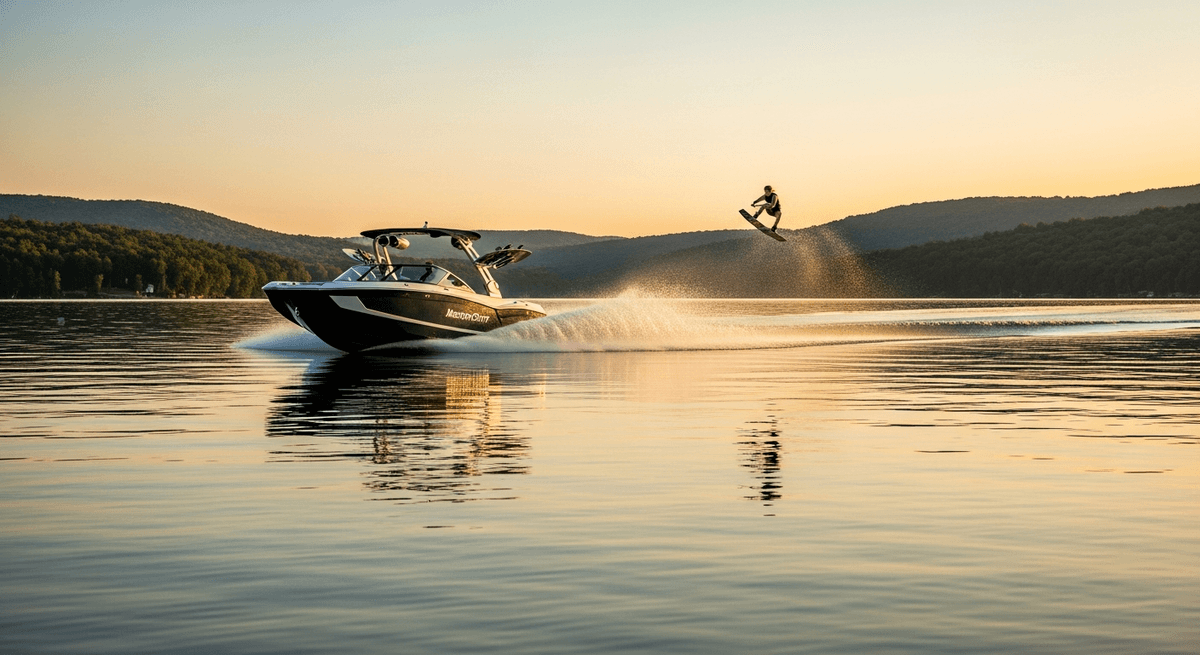
The term "wake boat" — sometimes called an inboard towboat, surf boat, or wake surf boat — refers to a purpose-built watercraft designed to produce large, shapeable wakes and surf waves for watersports. Unlike sterndrive or outboard-powered boats, wake boats use an inboard engine with a direct-drive or V-drive transmission and a fixed propeller under the hull. This configuration eliminates the exposed spinning propeller from the swim platform area, making it safer for riders in the water, and allows sophisticated ballast systems to manipulate hull trim in real time.
The modern wake boat segment is dominated by a small group of American manufacturers: MasterCraft (publicly traded, Vonore, Tennessee), Correct Craft/Nautique (private, Orlando, Florida), Malibu Boats (publicly traded, parent of Malibu, Axis, Cobalt, and Pursuit), and Skier’s Choice (Supra and Centurion, now owned by Malibu Boats). These brands have defined the premium category for 30+ years and their boats occupy a unique position in the market: expensive to purchase, expensive to operate, but surprisingly strong in retained value.
Understanding wake boat costs requires understanding this context. You are not buying a $40,000 runabout. You are entering a category where base models start near $90,000 and fully optioned flagship boats regularly exceed $300,000. The operating economics follow accordingly.
Wake boating has also become genuinely mainstream over the past decade. The sport of wake surfing in particular — accessible to beginners, low-impact on the body, and social in nature — has driven demand for surf-capable boats from an entirely new demographic of buyers. Many current owners had never owned a boat before purchasing their wake boat. That context matters for this guide: we assume no prior boat ownership experience and aim to cover every cost that a new owner might not anticipate.
2. Purchase Price: New & Used
New Boat Pricing (2024–2025 Models)
Published MSRP figures in this segment are best understood as floors, not ceilings. Every manufacturer offers an extensive option list — premium sound systems, upgraded tower packages, surf systems, ballast upgrades, hull graphics, custom upholstery, and technology packages — that routinely adds $20,000–$60,000 above base price. A buyer who walks into a dealer expecting to pay base price and leaves with a fully equipped boat will typically spend 20–40% more than the advertised number.
| Model | Base MSRP (2024–2025) | As-Optioned Range | Tier |
|---|---|---|---|
| MasterCraft X24 | $226,900 | $333,000–$342,000 | Premium flagship |
| MasterCraft NXT Series | $105,000–$135,000 | $130,000–$160,000 | Entry/mid |
| Nautique Super Air G23 | $185,000–$215,000 | $240,000–$280,000 | Premium flagship |
| Nautique G23 Paragon | $250,000+ | $290,000–$320,000 | Ultra-premium |
| Malibu Wakesetter 23 LSV | $159,900–$187,000 | $200,000–$220,000 | Premium mid |
| Supra SV | ~$190,000 | $215,000–$235,000 | Premium mid |
| Supra SA | ~$208,000 | $235,000–$255,000 | Premium |
| Centurion Fi23 | ~$171,000 | $190,000–$215,000 | Mid/value premium |
| Axis T250 (Malibu value brand) | $140,000–$170,000 | $170,000–$190,000 | Value tier |
| Axis A20 | ~$90,000 | $105,000–$120,000 | Entry |
| Moomba / Heyday (surf-capable) | Under $100,000 | $95,000–$115,000 | Budget/entry |
Used Market Pricing
The used wake boat market is one of the most fascinating in recreational boating. Unlike many powerboat categories where depreciation is severe and linear, premium wake boats hold value remarkably well — particularly top-tier brands with established tournament pedigrees.
| Model | Used Market Average | Range | Notes |
|---|---|---|---|
| MasterCraft X24 (used) | ~$179,700 | $105,000–$406,000 | Wide range by year and options |
| Nautique G23 (used) | $188,000–$191,000 | $90,000–$300,000+ | Best retention in segment |
| Malibu Wakesetter 23 LSV (used) | ~$99,925 | $25,000–$187,000 | Broad year range; volume depresses avg |
| Centurion Fi23 (used, recent) | $108,000–$150,000 | $75,000–$165,000 | Strong demand for 2018–2022 models |
COVID Distortion and Market Reality
The 2020–2022 pandemic years created an extraordinary demand spike in recreational boating. Production was constrained, wait lists stretched 12–24 months, and used boat prices in some cases exceeded original MSRP. That distortion has partially — but not fully — corrected. 2020–2022 model year wake boats still command premiums relative to pre-pandemic norms, and anyone buying used in this cohort should be aware they may be paying a still-elevated price that could soften further in 2025–2027 as inventory normalizes.
The practical depreciation curve for a new premium wake boat looks like this:
- Year 1: 15–20% loss off original purchase price (the steepest drop)
- Years 2–4: Gradual decline; total loss of 25–35% from new
- Years 5–7: Depreciation floor — value stabilizes; retain 65–75% of original
- Years 8–12: Condition and hours become primary value drivers; brand matters less
- Year 12+: Collector value for pristine low-hour examples; significant discounts for high-use boats
3. Depreciation & Value Retention
Depreciation is the silent cost that most first-time boat buyers underestimate. On a $200,000 new wake boat, that first-year 15–20% drop represents $30,000–$40,000 in lost value — more than the cost of fuel, storage, insurance, and maintenance combined in most scenarios. If you plan to sell within five years, depreciation will likely be your single largest ownership cost.
Brand Retention Rankings
Not all wake boats depreciate equally. Industry data and resale market analysis consistently rank the major brands in this order for value retention:
Private company ownership (Correct Craft) means production is deliberately constrained to match demand. Tournament dominance in competitive wakeboarding and wake surfing circuits creates perpetual aspirational demand. G-series boats from 2018+ retain value extremely well; G23 used averages approach new pricing for recent model years. The brand’s consistent tournament presence means even older Nautiques maintain cachet.
A publicly traded company with broader production volume than Nautique, but strong brand loyalty, a robust dealer network, and industry-leading warranty coverage (5 years bow-to-stern, 7 years/1,000 hours on the engine) all support resale value. X-series flagship boats depreciate more slowly than NXT entry models. The 5-year warranty transfers to subsequent owners on engines, which materially supports resale.
Highest production volume in the premium wake segment means more used boats in the market at any given time — the primary reason Malibu depreciates somewhat faster than Nautique or MasterCraft. Still retains value far better than most powerboat categories. The LSV and Response series maintain strong resale demand. Malibu’s vertical integration benefits its supply chain but does not directly affect wake boat resale.
Now owned by Malibu Boats, Supra and Centurion represent the value tier of the premium wake segment. Good build quality and capable wake/surf performance, but less brand prestige than the top three. Fi23 and SA models hold value reasonably well. Buyers looking for the most boat per dollar often find excellent value in 2–4-year-old examples of these brands.
4. Financing Costs
The majority of new wake boat purchases are financed. Marine loans differ from auto loans in several important ways: terms are typically longer (10–20 years), interest rates have historically been higher than auto loans, and the collateral — a depreciating recreational asset — means lenders price risk accordingly. In the current rate environment (2024–2025), marine loan rates for well-qualified borrowers typically run 7–9% for 10–15 year terms.
| Loan Amount | Rate | Term | Monthly Payment | Annual Payment | Total Interest Paid |
|---|---|---|---|---|---|
| $100,000 | 7.5% | 15 years | $927 | $11,124 | $66,840 |
| $150,000 | 7.5% | 15 years | $1,390 | $16,680 | $100,200 |
| $160,000 | 7.5% | 15 years | $1,483 | $17,796 | $106,800 |
| $200,000 | 7.5% | 15 years | $1,854 | $22,248 | $133,440 |
| $200,000 | 9.0% | 15 years | $2,028 | $24,336 | $164,880 |
In the early years of a marine loan, very little of each payment reduces principal. On a $160,000 loan at 7.5%, the first year’s payments total roughly $17,800 — but approximately $11,800 of that is interest. This front-loaded interest structure, combined with steepest depreciation in Year 1, means the first year of financed wake boat ownership is financially the most punishing.
5. Storage by Region
Storage is where wake boat ownership costs diverge most dramatically by geography. A Midwest owner on an inland lake in Wisconsin may pay $2,000–$4,000 per year for winter storage. The same boat at Lake Tahoe can cost $12,000–$23,000 per year in storage alone. This single line item can define the entire economic calculus of ownership in certain markets.
Midwest (5-Month Season)
The Midwest — Wisconsin, Minnesota, Michigan, Illinois, Indiana, Ohio — offers excellent wake boating on thousands of inland lakes, but a compressed season of roughly Memorial Day through Labor Day (5 months). This means 7 months of paid winter storage, significant winterization costs, and a relatively high cost-per-use-day ratio.
- Indoor winter storage: $50–$120 per linear foot for the season; a 24-foot boat runs $1,200–$2,880 for winter alone
- Lake Michigan region: $10/sq ft in Chicago-area marinas; $7.95/sq ft in Racine, WI
- Summer slip or dry dock: $800–$3,500/season depending on marina quality and location
- Total annual storage range: $1,200–$8,000/year
- Winterization cost: $400–$700 basic; $600–$1,000 full ballast system winterization
Southeast (8–9 Month Season)
Georgia, Tennessee, the Carolinas, Alabama, and Florida offer dramatically extended seasons — often March through November — which lowers the cost-per-use-day substantially. Storage costs are moderate, winterization is minimal (often $0–$300 in the deep South), and the boating lifestyle is year-round. Lake Lanier (Georgia), Percy Priest (Tennessee), Smith Mountain Lake (Virginia), and Jordan Lake (North Carolina) are all premium wake boat destinations with competitive storage markets.
- Covered boat storage: $75–$150/month ($900–$1,800/year)
- Lake Lanier, GA seasonal slip: $2,100–$6,000/year
- Uncovered dry storage: $50–$100/month
- Winterization: $0–$300 depending on climate and distance from frost
- Total annual storage range: $1,200–$6,000/year
Mountain West / Lake Tahoe (Premium Market)
Lake Tahoe is the most expensive recreational boating environment in the continental United States. At-lake storage is constrained by an extremely limited number of permitted slips and dry racks; demand vastly exceeds supply; and the combination of altitude (6,225 feet), hard winters, and strict environmental regulations (TRPA) creates a cost structure unlike anywhere else in the country.
- At-lake dry rack storage (Tahoe): Starting at $1,949/month — yes, per month
- Annual at-lake storage cost: $12,000–$23,000/year
- At-lake pricing: ~$21/linear foot/month at Tahoe marinas
- Off-lake storage (Reno, Sierra foothills): $200–$275/month — dramatically cheaper but requires trailering to the lake
- Fuel dock prices at Tahoe: $5.00–$6.00+ per gallon (vs. $3.50–$4.50 average elsewhere)
- Dealer labor rate at Tahoe: $150–$250/hour (vs. $100–$175 national average)
Southwest / Lake Powell (AZ/UT)
Lake Powell sits on the Utah/Arizona border and is managed by the National Park Service. Dry storage at Wahweap, Bullfrog, and Antelope Point marinas runs $1,680–$2,520/year — relatively affordable by premium lake standards. However, Utah state law imposes a mandatory 30-day drying period for boats that have been in certain waters before they can launch in others, which affects scheduling for owners who boat multiple bodies of water.
Storage Type Comparison
| Storage Type | Cost Range | Best For | Considerations |
|---|---|---|---|
| At-home (driveway/garage) | $0 (plus capital cost of covered structure) | Rural/suburban owners with space | HOA restrictions common; trailer maintenance required |
| Off-site dry storage (uncovered) | $50–$120/month | Budget-conscious owners | UV and weather exposure; no immediate launch |
| Off-site covered storage | $75–$200/month | Most owners | Best value for boat condition preservation |
| Marina dry stack | $150–$500/month | High-use owners, convenient launch | Call-ahead launch; limited availability in some markets |
| Wet slip (seasonal) | $100–$800/month | Daily-use owners, lake property | Hull fouling; must remove for winter in cold climates |
| At-lake (Tahoe/premium) | $400–$1,949+/month | Premium market owners | Extremely limited availability; waitlists common |
6. Insurance
Wake boat insurance typically runs 1–1.5% of hull value annually. On a $150,000–$200,000 boat, that translates to $1,500–$3,000 per year for a base policy. But the base number understates what thoughtful wake boat owners actually spend — and should spend — on coverage.
Coverage Essentials for Wake Boats
Agreed Value vs. Actual Cash Value: This is the single most important coverage decision you will make. An agreed value policy pays you the full insured value if the boat is totaled or stolen — no depreciation applied. An actual cash value (ACV) policy pays depreciated value. On a $200,000 boat that is declared a total loss after five years, the difference can be $40,000–$60,000. Always insure a premium wake boat on agreed value.
Watersports Liability: Standard homeowner umbrella policies do not cover activities towed behind a boat. A rider who is injured while wake surfing or wakeboarding behind your boat can expose you to significant liability. Watersports-specific liability coverage — sometimes called towboat liability or towed rider liability — is essential and should be clearly stated in your policy, not assumed.
Tower and Audio Equipment: Modern wake boats often carry $8,000–$20,000+ in audio equipment and tower-mounted hardware. These items must be explicitly declared and scheduled on the policy. Many owners discover at claim time that their factory-installed and aftermarket audio is underinsured or excluded entirely.
Passenger Count and Usage: Carriers ask about typical passenger counts. Wake boats routinely carry 8–12 people; some policies have limits or surcharges above a certain headcount. Disclose honestly — misrepresentation can void a claim.
Tournament and Competition Use: If you compete in organized wake/surf events, your recreational policy may not cover damage or liability sustained during competition. Tournament riders should discuss this explicitly with their broker before any event.
Key Insurers for Wake/Ski Inboards
The specialist insurer for ski and wake inboards. Policies are purpose-built for this boat type, with explicit watersports liability, tower equipment coverage, and agreed value as the default offering. Widely regarded as having the best understanding of wake boat risk in the industry.
Best for: Premium wake boats with heavy use, large audio systems, tournament participants
Specialty insurance carrier with strong marine products. Agreed value policies available; competitive pricing for newer boats with good operator history. Well-regarded claims service and responsive underwriting.
Best for: Mid-tier boats, first-time boat owners wanting specialty coverage
The largest volume marine insurer in the US. Broad network of surveyors and repair facilities. Pricing is competitive but policies can be more generic — review watersports liability language carefully before binding coverage.
Best for: Owners who want bundling discounts and wide availability
Mainstream carriers with marine products. Progressive’s boat insurance has improved significantly in recent years. Foremost (Farmers subsidiary) has strong inland lake presence. Pricing can be competitive for lower-value boats.
Best for: Entry-tier boats, owners with existing Progressive auto/home relationships
Sample Annual Insurance Costs
| Boat Value | Coverage Type | Estimated Annual Premium |
|---|---|---|
| $90,000 (Axis A20) | Agreed value, $500K liability | $900–$1,350 |
| $150,000 (Malibu LSV) | Agreed value, $500K liability | $1,500–$2,250 |
| $200,000 (MasterCraft X24) | Agreed value, $1M liability, tower/audio declared | $2,000–$3,000 |
| $250,000+ (Nautique G23 Paragon) | Agreed value, $1M liability, full declarations | $2,500–$3,750 |
7. Fuel Consumption & Annual Costs
Wake boats run large displacement inboard engines — typically 5.7L to 6.2L V8s producing 375–450+ hp. Fuel consumption is significant but highly variable depending on activity, ballast load, and boat speed. The good news: wake surfing is actually one of the more fuel-efficient recreational boating activities on a per-hour basis. The bad news: all-day mixed use with heavy ballast and multiple activities can consume 8–10 gallons per hour consistently.
Consumption by Activity
| Activity | Speed | Ballast | Consumption (GPH) |
|---|---|---|---|
| Wake surfing | 10–11 mph | Full (1,500–3,500 lbs) | 4.5–7.0 |
| Wakeboarding (light) | 20–22 mph | Minimal | 7–9 |
| Wakeboarding (loaded) | 20–22 mph | 1,200+ lbs added | 10–13 |
| Slalom water skiing | 30–36 mph | None | 9–14 |
| Cruising/idle | 15–25 mph | Varies | 6–9 |
| All-day mixed use average | Mixed | Mixed | 7–8.5 |
Annual Fuel Cost Estimates
These estimates use $4.00/gallon as a baseline fuel cost (road price), with fuel dock markup of $0.50–$1.50/gallon above road price, yielding $4.50–$5.50/gallon at the dock in most markets. Tahoe owners should budget $5.00–$6.00+/gallon.
| Usage Level | Annual Hours | Gallons Used | Annual Fuel Cost (Avg Market) | Annual Fuel Cost (Tahoe) |
|---|---|---|---|---|
| Light | 40 hrs | ~280–340 gal | $1,120–$1,260 | $1,400–$2,040 |
| Moderate | 60 hrs | ~420–520 gal | $1,920–$2,160 | $2,100–$3,120 |
| Average (typical owner) | 75 hrs | ~525–640 gal | $2,550–$2,870 | $2,625–$3,840 |
| Heavy | 100 hrs | ~700–850 gal | $3,600–$4,050 | $3,500–$5,100 |
| Very Heavy | 150 hrs | ~1,050–1,275 gal | $6,000–$6,750 | $5,250–$7,650 |
The average wake boat owner uses approximately 67 hours per year — call it a $2,200–$2,500 annual fuel bill at a typical Midwest or Southeast lake. This is often the most underestimated major cost because it is highly visible (you feel every fill-up) but also highly variable and easy to rationalize in the moment. Track your hours; the math has a way of surprising owners who do not.
Fuel Efficiency Tips That Actually Work
- Wake surfing instead of wakeboarding saves 3–6 GPH per hour of activity — meaningful over a season
- Keeping the hull clean and free of growth reduces drag (matters more for boats that sit in wet slips)
- Proper prop pitch matching to ballast load; an incorrectly pitched prop costs fuel efficiency at every RPM
- Avoid running at partial throttle in the "hole" — the mid-range RPM range where V-drives are least efficient; either surf or cruise, minimize time in transition
- Filling ballast before departure rather than running the pumps while underway saves minutes of heavy-load operation per session
8. Maintenance & Service
Wake boats are mechanically simpler than outboard or sterndrive boats in some ways — there is no lower unit, no outboard to flush, no trim motor — but they have unique service requirements driven by their ballast systems, direct-drive or V-drive transmissions, and raw water cooling systems. Proper annual maintenance is non-negotiable; deferred maintenance in a boat with 500–1,500 gallons of ballast plumbing is an expensive mistake.
Annual Routine Maintenance
| Service Item | DIY Parts Cost | Dealer Installed Cost | Frequency |
|---|---|---|---|
| Engine oil & filter change | $40–$80 | $300–$500 | Annual or every 50–100 hrs |
| Impeller replacement | $30–$60 | $150–$400 | Annual (critical — never skip) |
| Spark plugs (8 cylinders) | $40–$80 | $150–$300 | Every 100–200 hrs |
| Transmission fluid (V-drive) | $20–$40 | $100–$200 | Annual |
| Fuel filter | $15–$30 | $75–$150 | Annual |
| Air filter | $15–$40 | $60–$120 | Annual |
| Ballast system winterization | $60–$90 (antifreeze) | $60–$100 per tank (3–5 tanks) | Annual (Midwest/Mountain) |
| Fuel stabilizer | $15–$30 | Included in winterization | Annual (off-season storage) |
| Zincs / anodes | $20–$60 | $80–$200 | Annual or as needed |
DIY annual service parts total (oil, ATF, antifreeze, fuel stabilizer, plugs, filters, impeller): approximately $224 for a well-prepared owner who sources parts competitively. This remarkably low number is achievable but requires mechanical confidence, proper tools, and willingness to do the work. Most owners are not doing this level of DIY.
Dealer 100-hour service: $1,200–$2,000 depending on what is found and corrected. Seattle Boat Company (a major MasterCraft/Nautique dealer) publishes winterization package pricing from $548 to $2,702 depending on scope — a useful real-world anchor for what this market segment charges.
Winterization
Winterization is mandatory in any climate where temperatures drop below 32°F. A wake boat’s raw water cooling system, ballast system, and related plumbing holds substantial water that will freeze, expand, and crack manifolds, exhaust risers, hoses, and fittings if not properly evacuated and protected.
- Basic engine winterization only: $400–$700
- Full winterization with ballast system: $600–$1,000
- Ballast system alone (3–5 tanks): $60/tank × 3–5 = $180–$300
- DIY winterization: Possible with training; improperly done, can result in $2,000–$15,000 in freeze damage
Annual Maintenance Budget by Scenario
| Scenario | Annual Maintenance Budget | Notes |
|---|---|---|
| DIY, new boat under warranty | $500–$800 | Parts only; dealer handles warranty items |
| Dealer service, new boat | $1,500–$2,500 | Annual service + winterization |
| DIY, 5–8 year old boat | $800–$2,000 | More wear items; ballast pump inspections |
| Dealer service, 5–8 year old boat | $2,500–$4,500 | Expected wear items plus labor |
| Dealer service, older/high-hour boat | $3,000–$6,000 | Higher probability of repairs needed |
Dealer Labor Rates
Marine dealer labor is not cheap. The national range for wake boat dealers is $100–$175/hour. Premium markets command premium rates: Chicago and Lake Tahoe area dealers routinely charge $150–$250/hour. A seemingly simple repair that takes 3 hours of tech time plus parts can easily reach $600–$900 before you leave the service bay. Always get an estimate in writing before authorizing work, and ask for the estimate to specify whether the quoted labor is capped or approximate.
Warranty Coverage
MasterCraft leads the industry with a 5-year bow-to-stern limited warranty and a 7-year/1,000-hour engine warranty — the best coverage in the segment. This warranty is partially transferable and provides meaningful support to resale value. Nautique and Malibu offer competitive but somewhat less comprehensive coverage. Extended warranties from dealers are available from approximately $3,000 for 3-year extended coverage — worth considering on high-option boats where electronics and technology systems can be expensive to repair outside warranty.
9. Hidden Costs Unique to Wake Boats
Every boat category has its category-specific costs. Wake boats have a particular set of expenses that first-time owners consistently fail to budget for — and that can add thousands of dollars per year to the true cost of ownership.
Technology Subscriptions
Modern wake boats are increasingly software-defined products. MasterCraft Connect and similar app-based features from other brands are moving toward subscription models for premium features. Currently running $100–$300/year for connected features, this cost is modest but likely to grow as manufacturers follow the automotive industry’s software-as-a-service transition. Budget for it now; the direction of travel is clear.
Ballast System Upgrades
The factory ballast system on almost every wake boat is considered merely adequate by enthusiast owners. The aftermarket ballast upgrade ecosystem is enormous and expensive:
- Individual fat sacs: $100–$400 each; most serious surf setups need 2–4 additional sacs
- WakeMAKERS upgrade kits: $200–$800 per kit
- Full aftermarket ballast system (pumps, sacs, plumbing, wiring): $1,500–$4,000 installed
- Known ballast pump failures: $300–$1,500 repair cost when they occur; expect at least one over 7–10 years of ownership
Audio System Upgrades
Wake boating has a cultural relationship with audio that is unlike most other watersports. The expectation — particularly among surf crowds — is loud, clear music at the beach, on the water, and overhead from tower speakers. Factory audio is universally described as inadequate by enthusiastic owners, and the upgrade market is substantial:
- Budget upgrade (tower speakers + head unit): $800–$2,000
- Mid-range (Wetsounds, Exile, JL Audio — full system): $3,000–$6,000
- High-end marine audio (premium tower system, subwoofer, amplifiers): $8,000–$20,000+
These are typically one-time costs, but they are real costs, and they must be declared on your insurance policy to be covered in the event of theft or total loss.
Wake Surf System (Aftermarket)
Not all boats come with powered surf gates from the factory. Adding an aftermarket surf system — which uses hydrofoils or gates to shape the wave without manual ballast adjustment — costs $2,000–$5,000 installed. Some owners add these to older boats to bring performance up to current standards. The systems work well but have known failure modes, and repair costs of $300–$1,500 are not uncommon over the life of the installation.
Boards, Ropes, and Gear
Equipment costs for a new wake boat owner starting from zero are significant:
- Wakesurf board: $300–$1,000 (entry to pro-level)
- Wakeboard + bindings: $400–$900
- Tow ropes and handles: $80–$200
- PFDs for crew (6–10 people): $300–$800 (budget $50–$80/person for quality vests)
- Tubes and towables: $100–$500
- Boarding ladder, safety throw bags, fire extinguishers: $200–$400
Total startup gear investment for a typical family: $1,500–$3,500. This is a one-time cost but should be included in first-year budgeting alongside the boat purchase.
10. Tow Vehicle & Trailer
This is perhaps the most widely overlooked cost in wake boat ownership discussions. A fully loaded premium wake boat — hull, water, fuel, ballast, passengers, gear — can weigh 7,000–12,000+ pounds. Safely towing this load requires a capable truck, and the market has moved to full-size trucks as the practical minimum for most applications.
Tow Vehicle Requirements
A 23-foot wake boat with factory ballast full weighs approximately 5,500–6,500 pounds dry. Add passengers, gear, and trailer tongue weight, and you are regularly managing 8,000–10,000 pounds of tow load. This puts most half-ton trucks at or near their tow rating limit; many experienced wake boat owners move to 3/4-ton trucks for the additional capacity and braking ability.
- Minimum practical (full-size 1/2-ton, e.g., Ford F-150, Silverado 1500): Will work for smaller/lighter boats; marginal for full-sized boats at maximum ballast
- Recommended (3/4-ton, e.g., Ford F-250, Ram 2500, Silverado 2500): $60,000–$90,000 new; the right tool for the job
- Alternative (full-size SUV — Chevy Suburban, Ford Expedition, Tahoe): Adequate for lighter boats; less capacity than a dedicated truck
If you do not already own a capable tow vehicle, allocate $60,000–$90,000 for a new 3/4-ton truck or $30,000–$55,000 for a used example in good condition. Financed at current rates, that adds $700–$1,200/month to your transportation costs — and the truck depreciates too.
Trailer Costs
| Item | Cost | Notes |
|---|---|---|
| Factory trailer (with boat purchase) | $3,000–$7,000 | Usually included or priced separately |
| Aftermarket bunk trailer upgrade | $4,000–$9,000 | If upgrading from roller to bunk style |
| Annual trailer maintenance | $200–$600 | Bearing repacks, lights, brakes, tires |
| Trailer bearing replacement (every 2–3 yrs) | $150–$400 | DIY possible; critical for safety on highway |
| Trailer registration (annual) | $25–$100 | Varies by state |
11. Registration & Taxes
Registration and tax costs are straightforward but often surprise first-time buyers with their scale — particularly sales tax on a $200,000 purchase.
Sales Tax
Sales tax on boat purchases ranges from 0% (states with no sales tax, such as Montana, Oregon, and New Hampshire) to 10%+ in states like California and Louisiana. On a $200,000 boat, the difference between a 4% and 9% tax rate is $10,000 — real money. Some owners intentionally structure purchases in lower-tax states, a legal strategy with specific requirements for residency and use that a tax professional should advise on.
| State | Sales Tax Rate | Tax on $200,000 Purchase |
|---|---|---|
| Montana / Oregon / New Hampshire | 0% | $0 |
| Tennessee | 7% (capped in some cases) | $1,600 (if capped) or $14,000 |
| Georgia | 4–8% (local adds) | $8,000–$16,000 |
| Florida | 6% + local (capped at $18,000) | Up to $18,000 |
| California | 7.25–10.25% (local adds) | $14,500–$20,500 |
| Washington | 6.5–10.4% | $13,000–$20,800 |
Annual Registration
- Tennessee: ~$62/year for recreational boats
- Georgia: $45–$220 per 3-year registration period
- Florida: $76–$105/year depending on length
- California: $64–$141/year (based on value)
- National average: $50–$150/year; not a significant budget line item
12. Annual Cost Scenarios by Region
The following scenarios synthesize all cost categories into realistic annual totals. They use specific boats, specific regions, and specific usage patterns to give you a concrete framework for planning your own ownership costs.
Boat: Used Malibu Wakesetter 23 LSV (~$85,000 cash purchase, 5 years old)
Location: Lake Lanier, Georgia
Season: 8–9 months; estimated 65–70 hours/year
Maintenance: DIY annual service
| Cost Category | Annual Cost |
|---|---|
| Storage (covered, Lake Lanier) | $2,400 |
| Insurance (agreed value, $85K boat) | $850–$1,100 |
| Fuel (65 hrs × 7 GPH × $4.75/gal) | $2,160 |
| Maintenance (DIY + winterization minimal) | $600–$900 |
| Registration | $50 |
| Miscellaneous (ropes, gear replacement) | $200–$400 |
| Total Annual Operating Cost | $6,260–$7,010 |
| Cost per day (365 days) | ~$17–$19/day |
| Cost per use day (~60 days on water) | ~$104–$117/use day |
No financing cost. No depreciation cost (stabilized 5-year-old boat). This is the best-case cash scenario for a real wake boat with genuine surf performance.
Boat: New MasterCraft NXT22 ($128,000 cash purchase)
Location: Inland Wisconsin lake
Season: 5 months; estimated 60–75 hours/year
Maintenance: Dealer annual service + winterization
| Cost Category | Annual Cost |
|---|---|
| Storage (covered indoor winter + summer slip) | $3,200 |
| Insurance (agreed value, $128K boat) | $1,280–$1,920 |
| Fuel (68 hrs × 7.5 GPH × $5.00/gal) | $2,550 |
| Maintenance (dealer service + full winterization) | $2,200 |
| Registration | $80 |
| Miscellaneous | $300–$500 |
| Total Annual Operating Cost | $9,610–$10,450 |
| Cost per day (365 days) | ~$26–$29/day |
Year 1 depreciation (~$20,000) would bring the true first-year cost to $29,610–$30,450 — roughly $81/day.
Boat: New Nautique G23 ($210,000 cash purchase)
Location: Lake Tahoe (off-lake Reno storage, trailering to Tahoe)
Season: 6 months; estimated 90–100 hours/year
Maintenance: Tahoe-area dealer
| Cost Category | Annual Cost |
|---|---|
| Storage (off-lake Reno, covered) + summer at-dock access | $5,500 |
| Insurance (agreed value, $210K boat, $1M liability) | $2,800–$3,200 |
| Fuel (95 hrs × 7.5 GPH × $5.50/gal Tahoe avg) | $3,919 |
| Maintenance (Tahoe-area dealer $175/hr) | $3,000–$4,000 |
| Registration (CA) | $141 |
| Miscellaneous + gear | $500–$800 |
| Total Annual Operating Cost | $15,860–$17,560 |
| Cost per day (365 days) | ~$43–$48/day |
At-lake Tahoe storage ($18,000–$23,000/year) instead of off-lake storage would push total annual cost to $28,000–$33,000/year — $77–$90/day.
Boat: New MasterCraft X24 ($185,000; $25,000 down, $160,000 financed at 7.5% / 15 years)
Location: Illinois inland lake
Season: 5 months; estimated 70 hours/year
Maintenance: Dealer service
| Cost Category | Annual Cost |
|---|---|
| Loan payments ($1,483/month × 12) | $17,796 |
| Storage (indoor winter + summer) | $4,000 |
| Insurance (agreed value, $185K) | $2,200–$2,800 |
| Fuel (70 hrs × 7.5 GPH × $5.00/gal) | $2,625 |
| Maintenance (dealer annual) | $2,000–$2,500 |
| Registration | $80 |
| Miscellaneous | $400–$600 |
| Total Annual All-In Cost | $29,101–$30,401 |
| Cost per day (365 days) | ~$80–$83/day |
Same boat as Scenario D, adding depreciation as an explicit economic cost.
First-year depreciation on $185,000 boat (18%): ~$33,300
Annualized 5-year depreciation ($185K to ~$130K): ~$11,000/year average
| Cost Category | Annual Cost |
|---|---|
| All cash operating costs (storage, insurance, fuel, maintenance, misc) | $11,305–$12,605 |
| Loan interest portion (Year 1 estimate) | ~$11,800 |
| Annualized depreciation (5-year average) | ~$11,000 |
| Principal repayment (equity building, cash out but not pure cost) | ~$5,996 |
| True Annual Economic Cost (interest + operating + depreciation) | ~$34,105–$35,405 |
| True cost per day (365 days) | ~$93–$97/day |
| True cost per use day (70 days on water) | ~$487–$506/use day |
The per-use-day figure is the most honest comparison point against renting or club membership. At $490/use day vs. $800/day for a rental, ownership wins on cost above roughly 35–40 use days per year — but only if you actually use it that often.
13. Brand-by-Brand Comparison
Choosing between MasterCraft, Nautique, Malibu, and their competitors involves more than specification sheets. Each brand has distinct characteristics that affect the total cost of ownership, the experience on the water, and the return at resale.
| Brand | Price Tier | Value Retention | Warranty | Dealer Network | Best For |
|---|---|---|---|---|---|
| Nautique | Premium–Ultra | Best in class | 3-year hull; competitive engine | Selective — fewer dealers | Resale value, tournament prestige |
| MasterCraft | Mid–Premium | Excellent | 5-yr hull / 7-yr/1,000-hr engine | Broad national network | Best warranty, broad dealer access |
| Malibu | Mid–Premium | Good | 3-year limited | Very broad | Volume buyer, features per dollar |
| Supra | Mid | Good | 3-year limited | Moderate (shared with Centurion) | Value in premium tier |
| Centurion | Mid | Good | 3-year limited | Moderate | Value in premium tier |
| Axis | Entry–Mid | Moderate | 3-year limited | Malibu dealers | Entry price; Malibu technology |
| Moomba/Heyday | Entry | Moderate | 3-year limited | Moderate | Budget surf performance |
The Nautique Premium Explained
Nautique consistently commands a premium — both at purchase and in resale — that is often difficult for first-time buyers to justify based on specification sheets alone. The premium is real and has several structural causes:
- Private company, controlled production: Correct Craft deliberately limits production to match premium demand, preventing inventory oversupply that would pressure prices down. They do not chase volume; they protect margin and exclusivity.
- Tournament dominance: Nautique is the official towboat of the World Wake Association and multiple major competition circuits. The halo effect of professional use translates directly to consumer desire, the same way a Formula 1 connection sells road cars.
- Generational brand loyalty: Families that grew up behind Nautiques buy Nautiques. The brand’s community is unusually cohesive and its forums (PlanetNautique) are exceptionally active with decades of institutional knowledge.
- Genuine engineering leadership: PCM engines in Nautique boats, SURF SYSTEM technology, and Nautique’s wave-shaping software (WAVEPLATE) are genuine competitive advantages that owners notice on the water. These are not merely marketing claims.
The MasterCraft Warranty Advantage
MasterCraft’s 5-year bow-to-stern and 7-year/1,000-hour engine warranty is the most comprehensive in the industry. For a buyer planning to own for 5–7 years, this warranty materially reduces maintenance cost risk — and it transfers to subsequent owners (engine warranty portion), which supports resale value. If you are comparing a new MasterCraft to a comparably priced Malibu, the warranty difference alone is worth several thousand dollars in expected-value terms when you price the probability of needing a warranty repair in years 4–5 of ownership.
14. Owner Personas: Real Cost Profiles
Real owners on TeamTalk and PlanetNautique forums have shared detailed cost data over years of discussions. These profiles synthesize what actual owners report spending, stripped of aspirational framing or defensive minimization.
Boat: 2019 Nautique G23, paid off
Location: Tennessee lake community
Annual hours: 65–70
Reported annual total: ~$4,000
Mooring + insurance + winterization + maintenance + gas, all in. Does all service himself, minimal upgrades, dry-stored in his own garage. A real but unusual outlier representing best-case ownership economics for an owner with mechanical skills, storage space, and a long season.
Boat: 2022 MasterCraft X23, financed
Location: Lake Michigan suburb (Kenosha/Racine area)
Annual hours: 75–90
Reported annual total: $28,000–$32,000 all-in
Includes loan payments (~$1,600/month), marina storage ($4,200), insurance ($2,400), dealer maintenance ($2,200), fuel (~$3,000), and miscellaneous gear and upgrades. Representative of a typical upper-middle-class Midwest family ownership experience.
Boat: 2021 Nautique G25, cash
Location: Incline Village, NV (Tahoe)
Annual hours: 80–100
Reported annual total: $38,000–$45,000
At-lake dry rack ($20,400/year), premium insurance ($3,200), Tahoe fuel costs ($5,000+), Tahoe dealer maintenance ($4,000+), and the incidental costs of a premium vacation-home-adjacent lifestyle. This is the cost ceiling for cash ownership.
Boat: 2017 Malibu 23 LSV, paid off
Location: Lake Lanier, Georgia
Annual hours: 40–50
Reported annual total: $7,500–$9,000
Dry storage ($1,800), insurance ($1,200), modest fuel spend ($1,500), some dealer maintenance ($1,500), and occasional gear purchases. Well-managed, conservative Southeast ownership profile at 45 hours per year.
Boat: 2023 MasterCraft X24 ($295,000 as-optioned), financed
Location: Colorado (altitude lake community)
Annual hours: 100–120
Reported/estimated annual total: $40,000–$52,000
Maximum loan payment on a $250,000 balance (~$2,300/month = $27,600/year), mountain lake storage ($5,000), insurance on a high-value boat with full audio declarations ($3,500), fuel at altitude — engines work harder, averaging 8.5 GPH; $5,100/year at 120 hours — premium dealer maintenance ($3,500), ongoing upgrade spending on audio and ballast (~$2,000/year), and gear. This is the profile that generates the "$47,000+/year true cost" data point that forum veterans warn about. Every line item is real; the cumulative number surprises almost everyone who has not done the math in advance.
15. Your Personal Cost Worksheet
Use this framework to estimate your own annual cost of ownership. Fill in the figures that apply to your situation. All ranges provided; use the midpoint if uncertain about your own numbers.
| Cost Category | Your Estimate | Low Reference | High Reference |
|---|---|---|---|
| Boat purchase / annual loan payments | $_______ | $8,400/yr ($700/mo) | $27,600/yr ($2,300/mo) |
| Annual depreciation (purchase price × 6–10% for years 1–5) | $_______ | $5,400/yr (on $90K) | $20,000/yr (on $200K, Year 1) |
| Storage (summer + winter) | $_______ | $1,200 (Midwest, basic) | $23,000 (Tahoe at-lake) |
| Insurance (1–1.5% of hull value) | $_______ | $900 | $3,750 |
| Fuel (hours × GPH × $/gal) | $_______ | $1,120 (40 hrs) | $6,750 (150 hrs) |
| Maintenance (DIY to dealer) | $_______ | $500 (DIY, new) | $6,000 (dealer, older) |
| Winterization (if applicable) | $_______ | $0 (Southeast) | $1,000 (full ballast) |
| Registration | $_______ | $50 | $200 |
| Technology subscriptions | $_______ | $0 | $300 |
| Gear replacement (annual) | $_______ | $200 | $1,000 |
| Upgrades (audio, ballast, etc.) | $_______ | $0 | $5,000+ |
| Tow vehicle annual cost (if attributable) | $_______ | $0 (existing vehicle) | $15,000+ (financed new truck) |
| TOTAL ANNUAL COST (operating + financing) | $_______ | ~$7,000 | ~$50,000+ |
| Estimated annual use days | $_______ | 25 days | 120 days |
| Cost per use day (total ÷ use days) | $_______ | $280/day (low use) | $100/day (heavy use) |
16. Buying vs. Club Membership vs. Renting
The only honest answer to "is it worth buying a wake boat?" requires comparing ownership against the alternatives — particularly boat clubs and day rentals. The math changes significantly depending on how many days per year you actually use the water.
The Boat Club Option
Services like Carefree Boat Club operate in most major boating markets and charge $600–$1,000/month for membership that includes unlimited access to a fleet of boats, including wake boats in many markets. Members pay no storage, no insurance, no maintenance, no depreciation. The boat is always clean, fueled, and ready to go.
- Annual cost: $7,200–$12,000/year
- Break-even vs. ownership: If you would own a $150,000–$200,000 boat and use it 30–40 days per year, the club is often cheaper on a per-day basis
- Limitations: Availability not guaranteed on peak summer weekends; you cannot customize the boat or store personal gear; no equity building; the boat changes when the club rotates fleet
Day Rental Option
Wake boat rentals at major lake destinations typically run $600–$1,200/day depending on boat and market. At $800/day and 30 use days per year, that is $24,000 annually — more expensive than many ownership scenarios and with none of the availability flexibility. Rental makes most sense for very occasional use (fewer than 15 days/year) or for trying a market before committing to purchase.
Break-Even Analysis
| Use Days/Year | Own (cash, $150K boat, SE) | Own (financed, Midwest) | Boat Club ($800/mo) | Rental ($800/day) |
|---|---|---|---|---|
| 15 days | $587/day | $1,800/day | $640/day | $800/day |
| 30 days | $293/day | $900/day | $320/day | $800/day |
| 50 days | $176/day | $540/day | $192/day | $800/day |
| 75 days | $117/day | $360/day | $128/day | $800/day |
| 100 days | $88/day | $270/day | $96/day | $800/day |
The crossover point where cash ownership in the Southeast beats a boat club on pure cost-per-day is approximately 40–50 use days per year. For financed Midwest ownership, the math may never favor ownership over a club on cost alone — ownership wins on experience, customization, availability, and lifestyle, not necessarily on economics.
17. Frequently Asked Questions
A premium wake boat — MasterCraft, Nautique, or Malibu — costs $11,000–$24,000 per year to own on a paid-off basis, equivalent to roughly $30–$65 per day. Finance it at current rates (7.5–9%) and add another $12,000–$14,000 per year in interest. The range reflects real regional differences: Lake Tahoe owners may spend $12,000–$23,000 in storage alone, while a Southeast owner with covered storage at a modest marina may spend $1,800–$2,400. Usage level matters too — every 25 additional hours per season adds roughly $800–$1,000 in fuel. The most comprehensive data from owner forums and cost analyses consistently points to $10,000–$20,000 per year all-in for a financed premium wake boat as the most realistic planning range for most buyers.
Exceptionally well compared to most powerboats, and better than almost any other recreational vehicle category. Premium wake boats retain 65–75% of original value after five years of normal use. Nautique holds value best due to limited production and tournament prestige; MasterCraft follows closely; Malibu shows slightly faster depreciation due to higher production volume. The COVID-era 2020–2022 model years still command premiums above pre-pandemic norms in 2025, though this distortion is gradually normalizing. Year 1 depreciation is steepest (15–20%), then the curve flattens dramatically — at years 5–7, values stabilize, and a well-maintained low-hour example holds value remarkably well into its second decade. Compare this to a fiberglass pontoon or bowrider, which may lose 50–60% of value in five years.
On the new side, the Axis A20 (Malibu’s entry brand) starts around $90,000 and represents the lowest entry point into genuine surf-capable inboard performance. Moomba and Heyday offer surf-capable boats under $100,000 with competitive specifications. For total annual operating cost, a paid-off used Malibu Wakesetter 23 LSV or comparable boat in the Southeast — bought for $40,000–$60,000 and maintained with DIY service — can be owned for as little as $7,500–$9,000 per year including storage, insurance, fuel, and maintenance. The lowest total ownership cost comes from buying a 5–7-year-old boat (past the steepest depreciation, but not yet into heavy repair years), paying cash, doing your own maintenance, storing it at home or inexpensively, and boating in a long-season, warm climate.
The average wake boat owner uses approximately 67 hours per year — less than many new owners expect when they first purchase. Active families often reach 75–100 hours; less engaged owners or those in short-season climates may log only 40–50 hours. The compressed Midwest season (5 months, often further constrained by weather, work, and competing activities) tends to produce lower hour totals than Southeast or Florida owners. A useful benchmark: most wake boat engine warranties run to 1,000 hours, which means the average owner takes 10–15 years to reach the warranty limit. Low-hour (under 200 hours) 8–10-year-old boats are common in the used market and represent excellent value — their mechanical life expectancy is substantial.
The financial case for ownership strengthens significantly above 50 use days per year, and weakens below 30 days. At current pricing, a financed premium wake boat costs $80–$130 per calendar day when you factor in all operating costs — or $400–$600 per actual use day at 50–75 days per year. That is expensive but not irrational for a family with multiple riders who use the boat regularly. The comparison that matters most is not "ownership vs. nothing" but "ownership vs. the next best alternative" — in most markets, that is a boat club membership at $700–$900/month. If you will use the boat more than 40–50 days per year and value the customization, availability, and community of ownership, the economics can favor buying. Below 30 days per year, a club almost always wins on cost. The non-financial factors — the culture, the ability to customize, the family experiences, the freedom to go when you want — are real and worth something. Only you can price them.
Wake surfing burns 4.5–7 GPH at 10–11 mph — the most fuel-efficient performance activity on a wake boat. Wakeboarding at 20–22 mph with full ballast burns 7–12 GPH, rising to 10–13 GPH with 1,200+ pounds added. For an owner who primarily surfs rather than boards, this can translate to $300–$600 in annual fuel savings at moderate use levels. Gear costs differ too: a wakesurf board runs $300–$1,000; a wakeboard with bindings runs $400–$900. In terms of boat hardware, wake surfing at low speed creates more sustained load on ballast systems and requires more weight management than wakeboarding — some surf-specific boats may need ballast system attention sooner in their service life. Both activities require the same core boat; the choice of sport does not significantly change the cost of the boat itself, just the per-hour fuel bill and the gear investment.
18. Glossary
| Term | Definition |
|---|---|
| Agreed Value | An insurance policy structure in which the insured value is agreed upon at policy inception and paid in full at total loss, with no depreciation applied. The preferred structure for premium wake boats. |
| Actual Cash Value (ACV) | An insurance policy structure that pays the depreciated market value of the boat at the time of loss. Can result in significant shortfalls on premium boats; generally avoided by knowledgeable owners. |
| Ballast System | The network of tanks, pumps, and plumbing that fills with water to increase the boat's weight and sink the hull deeper, creating a larger wake or surf wave. Modern premium wake boats carry 1,500–4,000+ pounds of ballast capacity. |
| Direct Drive | An inboard drivetrain configuration in which the engine is mounted in the center of the boat and connects directly to a shaft and propeller. Produces a symmetrical wake; preferred for traditional water skiing and wakeboarding. |
| Fat Sac | An aftermarket ballast bag made of flexible PVC or similar material, used to add ballast capacity beyond the factory-installed system. Available in sizes from 50 to 1,100+ pounds. |
| GPH | Gallons Per Hour; the standard measure of marine fuel consumption. |
| Impeller | A rubber rotating component in the raw water pump that circulates cooling water through the engine. Critical maintenance item; should be replaced annually or every 100 hours. Failure causes engine overheating and can cause catastrophic damage if not caught quickly. |
| Inboard | An engine configuration in which the motor is mounted inside the hull, connected to a fixed driveshaft and propeller below the boat. Eliminates the exposed propeller hazard near the swim platform, making it inherently safer for water sports riders. |
| MSRP | Manufacturer's Suggested Retail Price. In the wake boat segment, this is consistently the floor, not the ceiling — most buyers pay 15–40% above base MSRP when options are added at the dealer. |
| PCM | Pleasurecraft Marine Engine Group; the manufacturer of the engines used in Nautique boats. Engines are purpose-built for marine inboard applications and differ significantly from automotive V8s in their cooling, oiling, and durability specifications. |
| Surf Gate / Surf System | A hydrofoil or tab system, either factory-installed or aftermarket, that deflects water to shape the surf wave without requiring manual crew weight adjustment. Standard on most premium wake boats; aftermarket kits available for retrofitting to older models. |
| TRPA | Tahoe Regional Planning Agency; the bi-state regulatory body governing development and environmental impacts around Lake Tahoe. TRPA regulations significantly constrain marina capacity, boat storage, and launch access, directly driving the extreme storage costs at Tahoe relative to other markets. |
| V-Drive | An inboard drivetrain configuration in which the engine is mounted at the rear of the boat, driving forward through a V-shaped transmission and shaft back through the hull. Frees up more interior floor space and creates a deeper, more surf-friendly wake. Dominant configuration in modern surf boats. |
| Wake Surfing | A watersport in which a rider surfs a continuous wave created by the boat without holding a rope, at speeds of 10–11 mph. Requires a surf-capable boat with ballast and a properly shaped hull or surf system. The dominant activity on modern wake boats and the primary driver of category growth over the past decade. |
| Wakeboarding | A watersport in which a rider stands on a board and performs aerial tricks while towed by a rope at 18–24 mph. Requires a large, clean wake and precise boat speed control. Preceded wake surfing as the primary use case for wake boats and remains popular, particularly for aerial trick riding. |
| Winterization | The process of preparing a boat for cold-weather storage by evacuating water from all raw-water-cooled systems, fogging the engine, stabilizing fuel, and otherwise protecting the boat from freeze damage. Mandatory in climates where temperatures drop below freezing; can cost $400–$1,000 professionally done. |
| Wet Slip | A marina berth where the boat floats in the water, tied to a dock. Convenient for daily use but exposes the hull to growth and requires winterization and physical removal in cold climates. |
Sources & Methodology
Purchase pricing sourced from manufacturer configurators and dealer inventory listings. Used market data from aggregated boat listing platform averages (Boat Trader, boats.com). Storage cost data from regional marina surveys and published marina pricing. Insurance premium ranges from published rate guides and owner-reported data. Fuel consumption data from manufacturer engine specifications, owner forum reporting, and marine publication testing. Maintenance cost data from dealer service menus and published owner records. All figures are representative ranges; actual costs vary by boat condition, use pattern, and market.
- MasterCraft Colorado — What Does a Wake Surf Boat Really Cost?
- Action Water Sports — MasterCraft Boat Price Guide 2025
- Boat Trader — MasterCraft X24 Listings
- J.D. Power — 2024 Centurion Fi23 Values
- Boating Magazine — 2024 Malibu Wakesetter 23 LSV
- Boatsetter — Complete Guide to Wakeboarding & Wakesurfing Boats 2026
- TeamTalk (MasterCraft Forum) — Fuel Consumption Thread
- TeamTalk — Typical Maintenance Costs Thread
- PlanetNautique — Real World Fuel Usage for Nautique Boats
- TeamTalk — Depreciation of a Used MasterCraft
- SkiSafe — Ski & Wake Inboard Boat Insurance
- Homewood Marina — Lake Tahoe Storage Rates
- GoldKey Marine — Lake Tahoe Boat Storage Guide
- FindBoatStorage.com — 2026 Boat Storage Cost Guide
- WakeMAKERS — Wake Boat Ballast Systems
- OnlyInBoards — What It's Like to Own a Wake Boat
- BoardCo — New vs. Used Wake Boat Guide 2026
- BoardCo — How Many Hours Are Too Many on a Used Wake Boat?
- BoatMart — The Cost of Winterization and De-Winterization
- Markel — Boat Insurance
- Wahweap Marina — Dry Storage at Lake Powell
- WorldMetrics — Wake Boat Industry Statistics 2026