
South Florida's yards are full, and the waterfront is fixed. RefitX, the new refit conference MIASF announced for FLIBS 2027, puts the spotlight on how the industry gets more work through the space it already has. The answer is throughput, and throughput is a coordination problem that AI agents and MCP are built to solve.
The hard ceiling on yacht refits
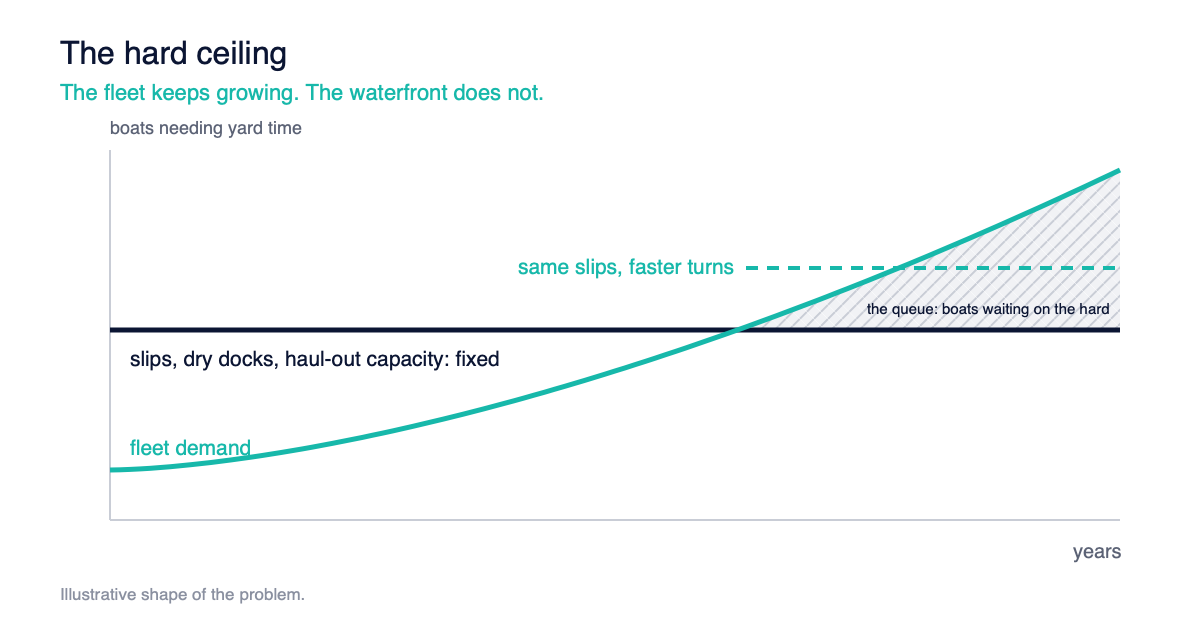
Yacht refit and maintenance is a multi-billion-dollar global business with one physical limit: nobody is building new waterfront.
- Slips and dry docks are bounded. Deepwater frontage in South Florida and every major yachting hub is spoken for.
- Rezoning is near impossible. Coastal land rarely converts to industrial marine use.
- The yards we have are the yards we will have. Today's slips, dry docks, and haul-out capacity are largely the ones the industry will run on decades from now.
The fleet keeps growing into that fixed footprint. Every extra day a boat sits on the hard waiting on an estimate, a sub, or a part is a day the next boat can't come out of the water.
What RefitX is
The Marine Industries Association of South Florida, owner of the Fort Lauderdale International Boat Show, and Informa Markets are launching RefitX: a dedicated two-day yacht refit conference and exhibition debuting October 27 and 28, 2027, at the Broward County Convention Center during FLIBS. Preview elements will be on the ground at FLIBS 2026 this month.
As MIASF CEO and President Phil Purcell pointed out in The Triton's coverage, South Florida is already the refit capital of the world. RefitX puts the commercial, technical, and operational realities of the sector on the main stage.
The real bottleneck is coordination drag
When people talk about yard capacity, they talk about linear feet of dockage, travel lift tonnage, and basin depth. Those are the physical limits, but they are rarely what is stalling a job today.
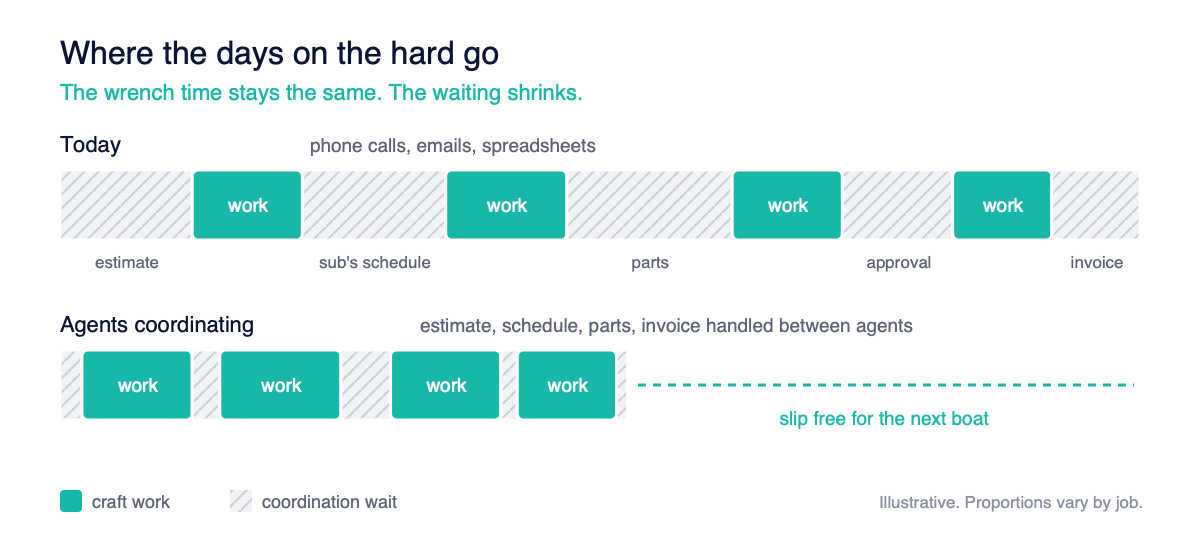
What holds up a refit turn is friction between the trades:
- Estimating latency: Days lost waiting on quotes from four different subs before the yard can present a scope to the owner.
- Scheduling conflicts: The paint crew can't start because the teak team is running two days late and nobody told them until Monday morning.
- Parts limbo: A custom through-hull fitting is delayed three weeks, but the sub didn't flag the lead time when the part was spec'd.
- Billing disputes: Change orders tracked in text messages and voice notes take three weeks to reconcile at the end of the job.
None of that work happens with a wrench. It is all coordination, and every day of coordination drag is an extra day that slip is occupied.
How AI agents compress the turn
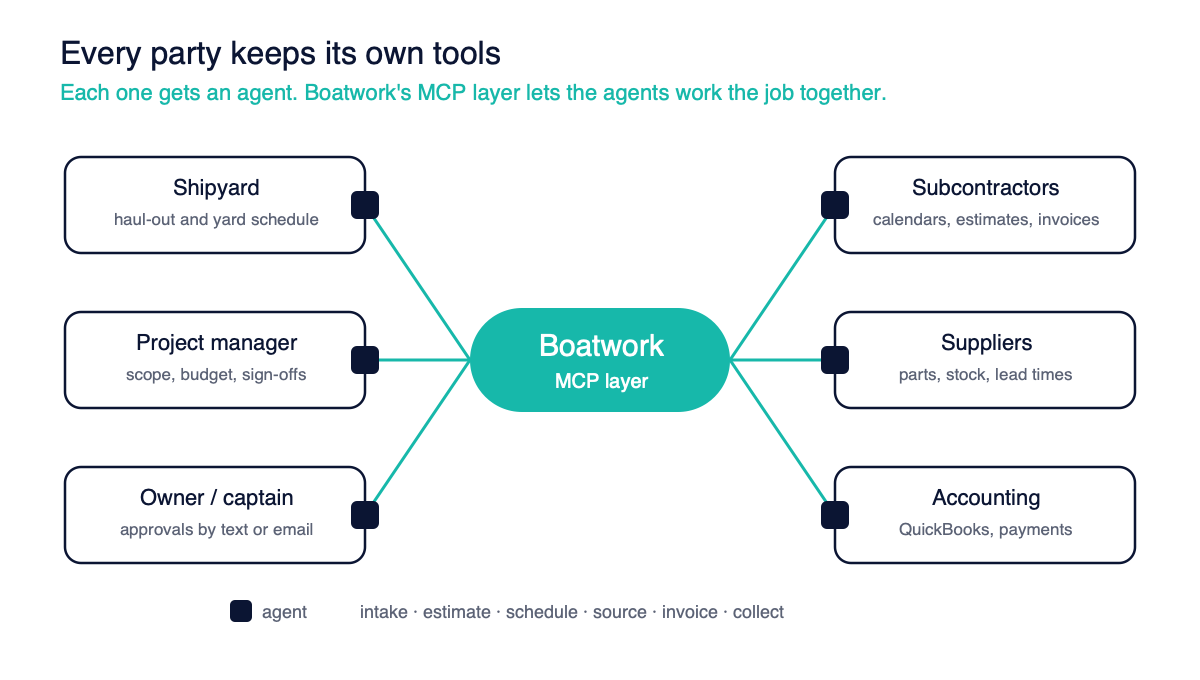
This is where autonomous AI agents change the math. Using Boatwork Assist, yards and marine trade contractors run agents that communicate directly with each other over Model Context Protocol (MCP).
Instead of five phone calls and a chain of unread emails to price a fiberglass repair, the yard's agent queries the composite contractor's agent. The composite agent checks its shop calendar, verifies technician certifications, applies agreed pricing, and returns a confirmed estimate and start date in minutes.
The human stays in the loop
Autonomous coordination doesn't mean removing people from the craft. It means removing people from the data entry. In an agent-to-agent workflow, the trade still turns the wrench; the agent handles everything around it:
- Agent: Coordinates the visit and locks the calendar slot.
- Agent: Pulls vessel specs and generates the preliminary quote.
- Agent: Routes the estimate to the project manager or owner for approval.
- Human: The technician completes the work.
- Agent: Submits the invoice, matches it to the work order, and closes the loop.
The leverage: more jobs through the same water
Compressing the turnaround time of a refit project by even 15% to 20% does something massive: it manufactures refit capacity out of thin air.
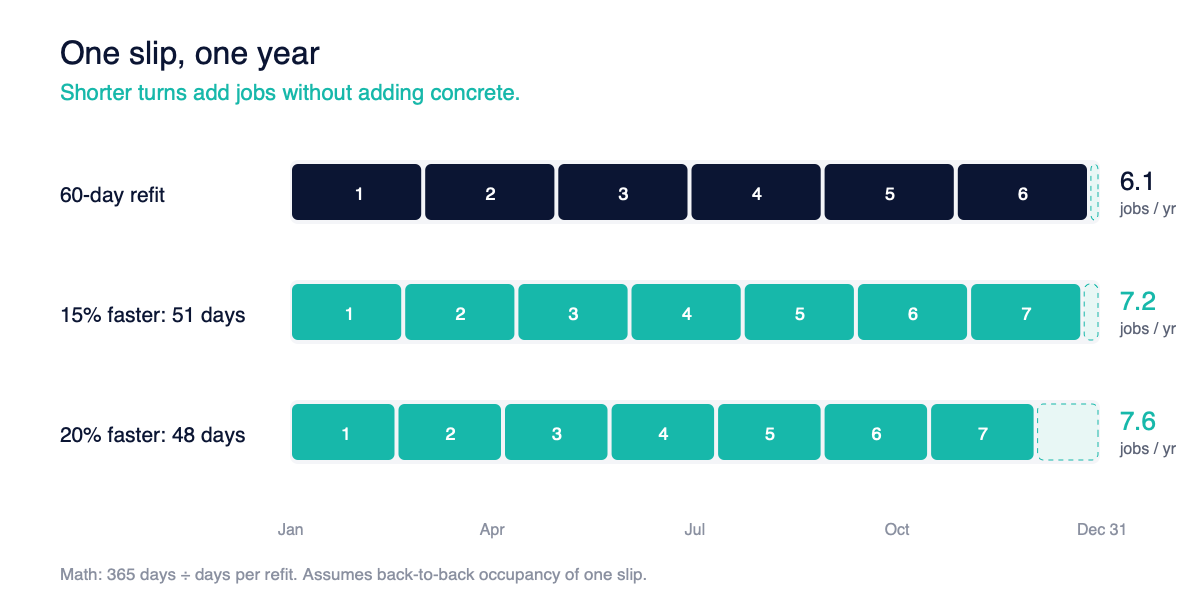
If a yard turns an average refit in 45 days instead of 60, that slip handles five boats a year instead of four. Across a facility with 20 slips, that is 20 additional major projects per year with zero new concrete, zero dredging, and no rezoning.
Building the rails
RefitX puts efficiency, technology, and operational modernization on the main stage of the biggest boat show in the world. Boatwork is building the rails the marine industry will run on: MCP-connected agents that take the coordination load off yards, subs, and project managers so more boats move through the same water. If you are at FLIBS this month, find us through the FLIBS 2026 show guide.
FAQ
What is RefitX?
A two-day yacht refit conference and exhibition from MIASF, debuting October 27 and 28, 2027, during the Fort Lauderdale International Boat Show. Preview elements run at FLIBS 2026.
Why can't yards just add capacity?
Waterfront is fixed. New slips and dry docks require land and permits that coastal markets like South Florida rarely grant, so added capacity has to come from faster turns.
What is MCP?
Model Context Protocol is an open standard that lets AI agents connect to the software a business already uses, such as calendars, email, accounting, and supplier systems, without replacing it.
Do AI agents do the refit work?
The agents handle intake, estimates, scheduling, parts tracking, invoicing, and collections. The trades do the work, and people make the approvals and judgment calls.
How much does Boatwork Assist cost?
$99 per agent per month plus usage. Marketplace leads are free.