There is no single best yacht maintenance service in the United States. The right provider depends on your boat's location, size and systems. Choose by ABYC certification, checked reviews and itemized estimates.
What does yacht maintenance actually include?
Yacht maintenance covers mechanical servicing, hull and gelcoat care, electrical systems, rigging and safety equipment inspections. Oyster Yachts describes annual services as in-water and out-of-water work, based on the yacht's condition and the season ahead.
That work can include a 100-point manufacturer check, safety equipment servicing and certifying, and checks of through-hull fittings and deck fixings. Hauling out allows new antifouling paint and servicing of the rudder, propeller, seacocks and thrusters.
Knowing these areas tells you which system needs attention and which type of pro to call. For engine-specific upkeep, see our boat engine maintenance guide.
How much should I budget for annual yacht maintenance?
Plan for roughly 3–5% of the yacht's value a year for routine maintenance, plus 1–2% set aside for a major refit. Yacht Market Intel gives those figures for professionally run motor yachts. Its all-in ownership range, including crew, fuel, berth and insurance, is 8–12% of value.
Here is a worked example for a $500,000 yacht:
- Refit reserve at 1–2%: $5,000 to $10,000 a year.
YachtWorld puts total annual ownership at 10–25% of value. On the same boat, that is $50,000 to $125,000 before leaving the dock. It also gives a rule of thumb of about 10% of value, or $50,000, for maintenance alone. Published rules differ, so treat them as ranges and compare local quotes.
What certifications should a marine technician hold?
Look for ABYC certification. The American Boat & Yacht Council certifies technicians in Marine Systems, Marine Electrical, Marine Corrosion, Marine Engines and Fuel Systems, ABYC Standards and Advanced Electrical. Initial certification takes a passing exam score plus 2 years of work experience, and it stays active for 5 years.
Match the specialty to the job:
- Electronics, panels and wiring: Marine Electrical or Advanced Electrical.
- Propulsion and fuel: Marine Engines and Fuel Systems.
- Stray current and zinc wear: Marine Corrosion.
- Plumbing, steering and general systems: Marine Systems.
ABYC certifies individuals, not facilities. It suggests asking about specialties and looking for certificates, stickers or uniform patches. A Master Technician holds at least three certifications.
What insurance should a service provider carry?
A reputable provider should carry general liability insurance and give you a certificate of insurance before work starts. That coverage matters if the tech damages your boat or property while working. Policy limits vary by provider, so ask what the certificate covers.
Request the certificate before you approve a work order. Check that the policy is current and that the named business matches the one on your estimate. If the shop hauls or moves your boat, ask whether that work is covered too.
How do I verify a provider's reputation?
Ask fellow boaters for referrals, read online reviews and forums, and check for complaints with the Better Business Bureau, as ABYC advises. Look for patterns of unresolved problems rather than a single bad review.
On a marketplace, pro profiles show reviews, service areas and verification details. You can also look up technicians in the ABYC certified tech directory, which lists active certifications. Ask the pro for recent jobs on boats like yours.
What should be in a maintenance estimate?
A good estimate itemizes labor, parts and fees, and states the scope of work and a timeline. Get these items in writing:
- Which systems are being serviced, such as the engine, electrical panel or hull fittings.
- Labor rate and estimated hours.
- Parts, with brands or grades where it matters.
- Any yard, haul-out or disposal fees.
- How the pro will handle extra problems found once things are opened.
- Start date and expected completion.
Require your approval before any added work. That one clause prevents most surprise charges.
Mobile mechanic or fixed yard: which is right for me?
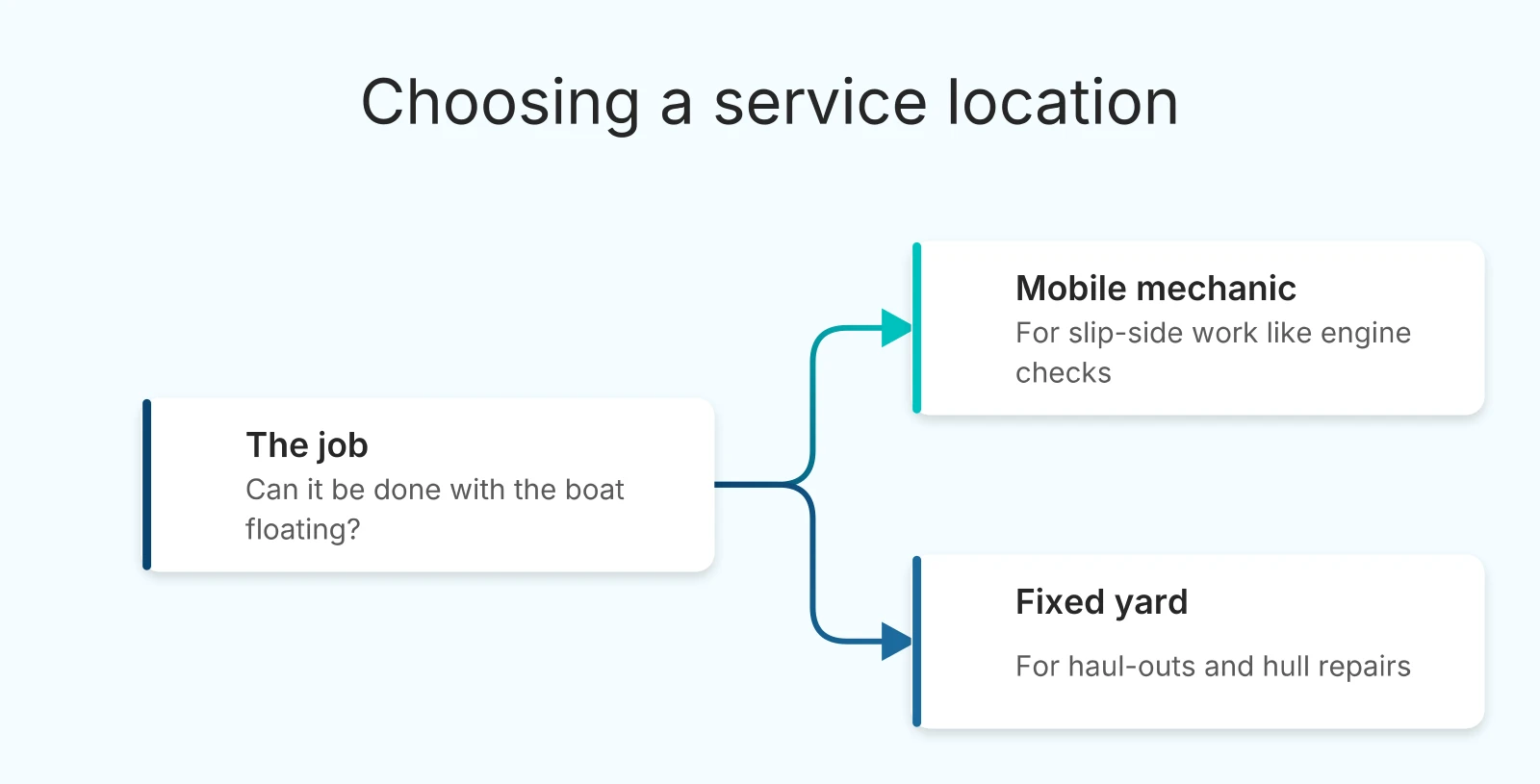
Use a mobile mechanic for slip-side work such as engine checks and electrical issues. Use a fixed yard when the boat must come out of the water. Haul-outs, antifouling, rudder and propeller work, and major hull or structural repairs need a yard with lifting equipment and space.
Oyster Yachts notes that service teams can come directly to you where necessary. A simple rule: if the job can be done with the boat floating, ask a mobile pro first. If it needs the hull dry, book a yard.
How often should I schedule maintenance, and what is a refit?
Schedule a full service once a year. Check wear items such as impellers, zincs and filters more often, depending on how much you use the boat. Older boats and high-use boats need closer attention to raw-water cooling parts and safety gear.
A refit is different. It is a major overhaul, such as a full repaint or machinery overhaul, that Yacht Market Intel says typically falls due every 5–7 years. That is why it recommends accruing 1–2% of value a year toward it. For scope and planning, read how to plan a boat refit.
How do I find a vetted pro in my area?
Browse pros by specialty and location on a marketplace, or search the ABYC directory by certification. ABYC reports more than 4,500 certified technicians nationwide, so check whether one works near your marina.
Boatwork connects owners with independent marine pros and does not perform the work itself. You describe your project, choose which pros to contact and get estimates only from them. Compare at least two quotes against the checklist above. You can start by describing your project at Boatwork.